

We nearly lost the sale over a patch of damp concrete in the basement. The inspector found an old seepage problem behind the washing machine, and the buyers asked for a credit to cover repairs. For two days June carried messages between us while Mark and I asked questions about estimates and closing costs. A year earlier he would have told me not to worry and handled it himself. This time he sent every document to both of us, waited for my answer, and accepted that I might disagree.
We agreed to a reasonable credit. The buyers kept their offer, and the closing moved ahead. I didn’t mistake that small cooperation for the return of our marriage. It was simply what two adults needed to do when the consequences of their choices still shared an address.
I moved into the duplex on a cold Saturday in December. Rachel drove in from Chicago, Tessa recruited two friends with a truck, and Mrs. Patel left a spare set of keys on the kitchen counter. We carried furniture through the doorway, rearranged the sofa twice, and discovered that the refrigerator hummed loudly enough to be heard from the bedroom. I made a note to mention it to the landlord. For once, an unexpected sound was only an appliance.
Daisy inspected every room before choosing a sunny square beside the living-room window. The first evening she hesitated at the back door. I opened it, walked outside with her, and waited while she sniffed the new yard. She came back in when she was ready. No one called her away. No one asked me to ignore her.
The next morning I went to the hospital, returned at lunchtime for her walk, and learned that I had misjudged how far the grocery store was from the duplex. The new routine wasn’t a montage of perfect beginnings. I lost my wallet for an hour among the unpacked boxes. Daisy knocked over a trash can. I cried while trying to hang a curtain rod because I’d spent a decade assuming there would always be someone on the other end to hold it level.
Tessa arrived with a toolbox and did the holding. We made crooked holes, patched them, and finally got the curtains up. She stayed for soup from a carton. Later, after she left, I sat on the floor with Daisy’s head in my lap. The apartment was quiet and a little drafty. I was lonely. I was also able to account for every key and every person who could come through the door.
The house closed in January after the remaining paperwork was resolved. The proceeds didn’t erase what Mark had lost. They paid the mortgage, sale expenses, and agreed adjustments, including reimbursement to me from his portion for part of the savings he’d used without my agreement. His remaining personal credit-card obligations were addressed in our settlement. We each reviewed the final figures with our attorneys. There was no hidden windfall or sudden fortune. There was simply a clear ledger where there had once been vague assurances.
Mark and I signed the necessary documents separately. At the closing office, I passed the old house key across the desk and felt a brief, sharp grief for the backyard I was leaving. I had loved that place. I still did. But a home isn’t something you preserve by ignoring what happens inside it.
Our divorce was finalized the following spring. We had settled the property issues through our lawyers, so the final steps were quieter than the unraveling had been. Mark wrote me a short letter afterward. He said he’d started counseling and was learning to tell the truth before fear turned into another story. He didn’t ask me to forgive him or to answer.
I read it once and put it away. I hoped he’d keep doing that work, whether or not anybody praised him for it. I didn’t need to supervise his improvement to make my own decision valid.
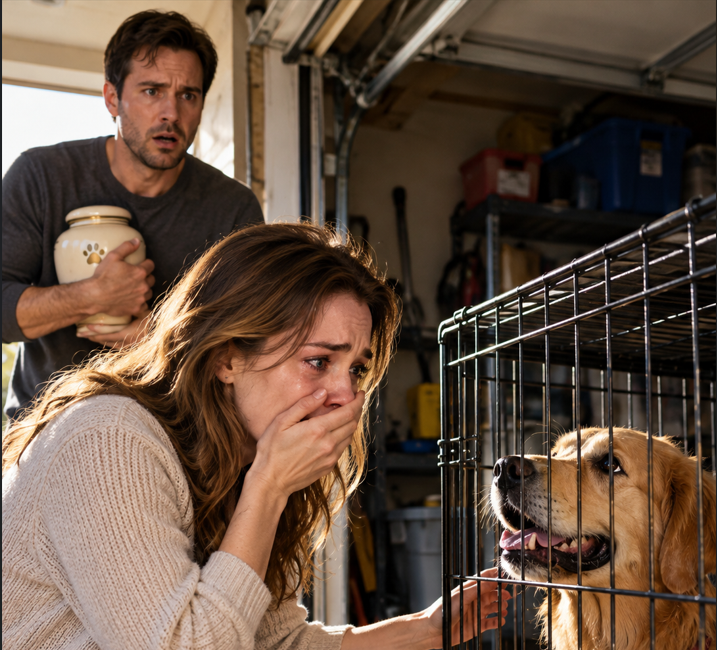
There was one thing left from the garage. During the move, Tessa had found the cream-colored urn on a high shelf and asked what I wanted done with it. I’d told her to leave it in a box until I could bear to decide. It sat unopened in the new hall closet for weeks, absurdly heavy for something that had always been empty of what I feared losing.
One Sunday I took it outside. The lid lifted easily. Inside lay the same gray ash Mark had gathered from our fire pit, a few flakes of charred wood among the powder. I tipped it into a lined trash bag, sealed the bag, and washed my hands. Then I wrapped the ceramic container and set it aside for disposal. I didn’t give it a ceremony. It had never held a life. It had held a lie.
Daisy watched from the doorstep, more interested in the sound of a squirrel along the fence than in what I was doing. Her arthritis still bothered her after long walks, so we kept them short. Dr. Shah had adjusted her treatment, and I learned the difference between a slow day and a day when she needed another checkup. She had grown a little whiter around her face. She still stole socks from the laundry basket whenever I forgot to close it.
In the spring, the woman who lived next door leaned over our fence while Daisy rolled in the grass. She asked how long I’d had her.
“Since the first year of my marriage,” I said automatically, then smiled.
“A long time. Almost her whole life.”
The woman scratched Daisy behind the ears and said she looked loved. I thanked her and went inside to prepare dinner, leaving the back door open while Daisy finished exploring the patch of sunlight near the maple tree.
I used to think trust meant never having to question the person beside you. After Mark, I knew that wasn’t quite right. Trust also had to leave room for the things I noticed, the questions I needed to ask, and the answers I deserved to hear. I hadn’t saved my marriage by opening the garage door. I had saved something quieter: the right to believe what I saw and make choices about the life in front of me.
From the yard came three quick scratches against the screen. I crossed the kitchen, opened the door, and Daisy walked in, her tail tapping my leg on the way to her water bowl.
THE END.