


“Their funeral isn’t important enough to ruin Matt’s vacation.”
That was the message my mother sent while I was standing at the cemetery, watching two coffins being lowered into the ground.
One belonged to my husband, John.
The other belonged to our seven-year-old daughter, Emma.
It was a cold Tuesday afternoon. My hands were shaking so badly I could barely hold my phone.
I had buried the two people I loved most in the world, and my own parents couldn’t be bothered to come home from the Caribbean.
My mother’s full message was even worse.
“I’m sorry, sweetheart. Flights are expensive, and honestly, this isn’t important enough to ruin your brother’s vacation.”
I read it three times.
Not because I couldn’t understand the words, but because I couldn’t believe my mother had actually written them.
I looked around the cemetery.
There were friends, neighbors, and people from John’s workplace. They stood quietly beside me, unsure what to say.
But my parents weren’t there.
Neither was Matt, my younger brother.
They were thousands of miles away, enjoying a beach resort.
I had called them when John and Emma died. I had told them the funeral date. I had even offered to help arrange their flights.
Nothing had changed their minds.
That afternoon, while I was still wearing my funeral dress, my mother posted a photograph on Facebook.
She stood between my father and Matt, all three smiling beneath a spectacular Caribbean sunset.
They were holding cocktails.
The caption read:
“Family is everything.”
I stared at the photograph until my phone screen went dark.
John would have known exactly what to say.
He had never hated my family. In fact, for years, he had tried to maintain a peaceful relationship with them.
But he saw things I refused to see.
Once, after my parents had asked me for another financial favor, he sat beside me at our kitchen table.
“Naomi, your family doesn’t ask for help,” he said. “They’re testing how much more they can take from you.”
I told him he was being unfair.
He didn’t argue.
He simply squeezed my hand and said he hoped I would never have to discover that for myself.
Standing in that cemetery, I finally understood.
Three days after the funeral, someone knocked on my front door.
I wasn’t expecting anyone.
The house had been painfully quiet since I returned from the cemetery.
Emma’s little pink backpack was still beside the stairs, exactly where she’d left it.
Her shoes were underneath the bench.
John’s jacket was hanging near the front door.
I hadn’t been able to move any of them.
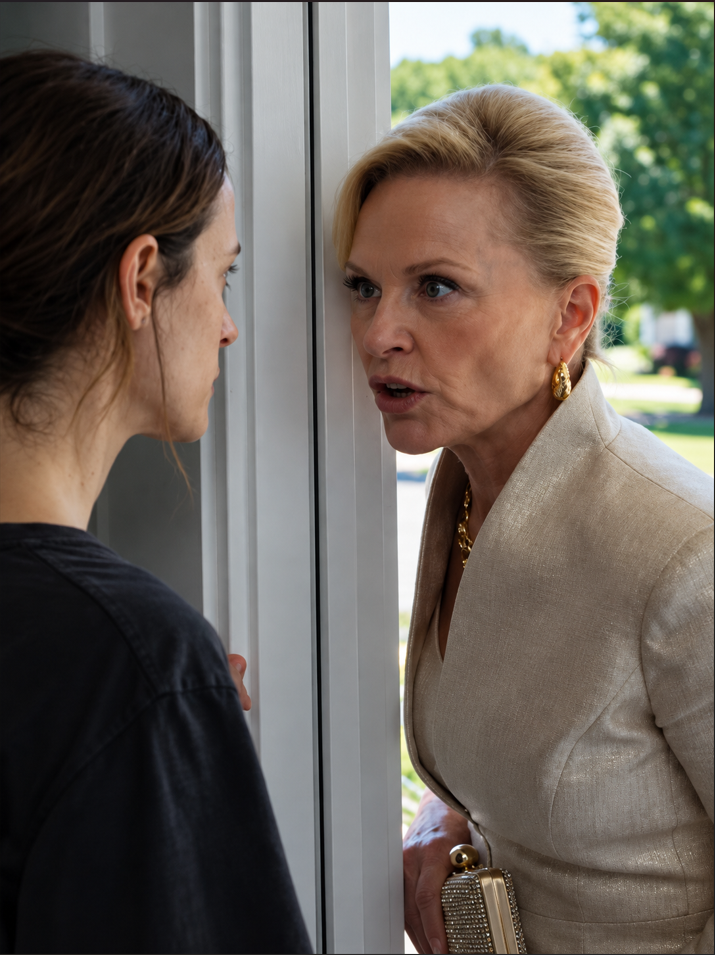
When I opened the door, my mother was standing on the porch.
My father stood beside her.
Matt was a few steps behind them, looking down at his phone.
They were wearing expensive linen clothes. Their skin was tanned, and my mother’s perfume carried the unmistakable scent of tropical sunscreen.
For a second, I thought they had finally come to apologize.
My mother looked me up and down.
“You look terrible,” she said.
I waited.
She glanced past my shoulder into the house.
“Anyway, we need forty thousand dollars.”
I actually thought I’d misheard her.
“What?”
“Forty thousand,” she repeated. “We need to get this sorted out quickly.”
She spoke as though she were asking me to pick something up from the grocery store.
My father stepped forward.
“Matt’s restaurant has a serious problem with the IRS. We have to deal with it before things get worse.”
I looked at my brother.
He finally put his phone down.
“It’s an emergency, Naomi. Please don’t make this a whole thing.”
For a moment, nobody spoke.
I could hear the refrigerator humming inside the kitchen.
My mother shifted impatiently on the doorstep.
“Well?” she asked.
I looked past them toward the driveway.
They had apparently driven straight to my house after returning from their vacation.
Not to ask how I was surviving.
Not to bring flowers for John or Emma.
They wanted money.
“You didn’t come to the funeral,” I said quietly.
My mother’s expression tightened.
“We’ve already been over this.”
“You missed John’s funeral. And Emma’s.”
“Naomi, don’t start.”
I felt something inside me go completely still.
Three days earlier, I had cried until my chest hurt. I had barely slept. I had walked through this house, opening drawers and closing them again because every ordinary object reminded me of someone who would never use it.
But standing in front of my parents, I didn’t feel like crying.
I felt strangely calm.
My mother crossed her arms.
“After everything we’ve done for you, you owe us.”
My father nodded.
“Families are supposed to help each other.”
I glanced toward Emma’s little backpack.
Then I looked at the black funeral dress lying across the chair near the stairs.
“Is that what you told yourselves on the beach?” I asked.
Matt made an irritated sound.
“Oh my God, Naomi. Can we just talk about the money?”
My mother stepped closer.
“Your brother could lose his business. Do you understand what that means?”
I looked directly into her eyes.
“Yes,” I said. “I understand exactly what it means to lose something.”
For the first time, she seemed unsure how to respond.
Then she shook her head.
“You’ve always been so dramatic.”
I didn’t argue.
I didn’t raise my voice.
Instead, I turned toward the narrow console table beside the front door.
A thick black folder was resting there.
My mother’s gaze followed my hand.
“What is that?” she asked.
I picked it up.
Matt stopped scrolling through his phone.
My father frowned.
I turned back toward them, holding the folder against my chest.
For the first time in my life, they had come to my door expecting something I was no longer willing to give.
I opened the folder.
On the first page was a large printed heading.
My mother leaned forward to read it.
The smug smile disappeared from her face.
Her lips parted slightly.
Then all the color drained from her cheeks.
My Family Skipped My Husband and Daughter’s Funeral, Then Demanded $40,000 Three Days Later
Page 1 of 5
Related Posts




Leave a Reply

At Her Husband’s Awards Dinner, Claire’s Daughter Asked Her for Five Minutes
Part 1 - The Five-Minute Promise “Mom, don’t go. Give me five minutes.” Claire Harrison had already picked up her...
Read moreDetails