

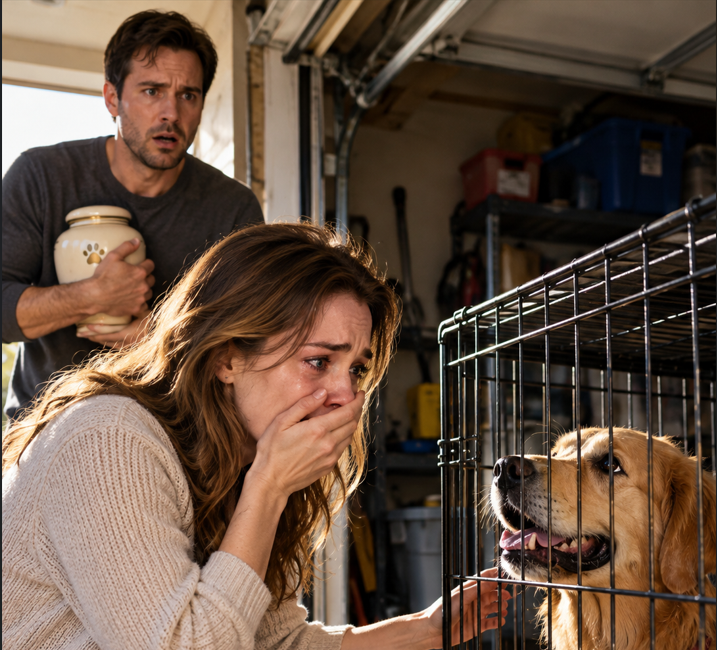
The phone number Mark had left on the garage shelf belonged to a woman named Lena Walsh. I waited until Tuesday afternoon to call, long enough to speak with Dana about what I should and shouldn’t say. Lena answered on the third ring, sounding hopeful.
“Is this about Daisy?” she asked.
“Mark said we’d hear from him yesterday.”
I explained that I was Daisy’s other owner, that she was safe, and that there had been a serious misunderstanding. I told her I was sorry before I had even finished the first sentence. She grew quiet as I spoke.
“He said you were on board,” she told me.
“He said moving was hard on everybody, but you’d both decided Daisy needed somewhere stable.”
“He didn’t ask me. I only learned about any of this on Sunday.”
“Oh,” Lena said softly.
Her husband, Victor, had retired that spring. They had a fenced yard, plenty of time, and an older retriever who had died the previous winter. They’d promised themselves they would adopt a senior dog when they were ready. Mark had sent photographs of Daisy, including one of her asleep beneath our Christmas tree. Lena’s granddaughter had drawn a picture of Daisy for the refrigerator. They had bought a new bed and arranged to be home all week.
I expected to feel anger when she described all that preparation. Instead I felt sick for both of us. Mark had taken an ordinary act of kindness—offering an aging dog a home—and turned it into another lie someone else would have to survive.
“I won’t be giving Daisy up,” I said.
“I understand if you’re upset.”
“I’m upset with him, not you. I’m glad she has someone who wants her.”
After we hung up, Lena sent me screenshots of their conversation. The first message was dated the Friday before I left for Chicago. Mark had told her we were facing an unexpected move and had agreed the dog couldn’t come. On the following Monday, before he’d called me to report Daisy’s death on Tuesday, he had arranged the pickup for my expected return day.
That was what changed the shape of the story for me. The lie wasn’t something he’d blurted out in a moment of panic. It had been scheduled. He’d written messages, chosen a kennel, measured a crate, and kept talking to me about groceries and our weekend plans while the arrangement grew around me.
I thanked Lena for telling me the truth. Before hanging up, I asked whether the bed and supplies she had bought could be returned. She said most could, and the rest would be donated to the shelter where she volunteered. It was a practical answer to an unfair disappointment, and I wished Mark had offered either of us that much consideration.
I printed the screenshots for Dana. Then I went home for the first time without Mark there, because he’d texted that he was staying with a friend while we worked out what to do. Tessa came with me. We opened the drawers where the dog supplies had been packed away. Behind Daisy’s winter coat was a folder labeled HOUSE OPTIONS in Mark’s block handwriting.
It contained printouts of apartment listings around Columbus, estimates for moving costs, and a handwritten list headed Things That Have to Go. Under old dining chairs and the broken lawn mower were the words: Daisy’s equipment. Farther down, in smaller letters: Find placement before Natalie returns.
Tessa read the line over my shoulder but didn’t say anything. She was wise enough not to offer a description of Mark that I might feel obliged to defend later. I folded the paper and put it with my other copies.
A house has so many places to hide ordinary things. Eleven years of closets and drawers had helped me believe that if something mattered, it would eventually come into the open. Now I knew how thoroughly someone could prepare a decision in a home shared with another person and still leave that person outside it.
The financial picture came into focus by the end of the week. From the records Mark finally sent, I could see the severance he’d received after losing his job, the transfers he made to Simon’s business, and the credit-card balances he’d accumulated on accounts in his name. Some money had paid household bills. Much of it had supported equipment purchases and subcontractor deposits for projects that never started. None of the documents proved an elaborate scheme to steal from me. They showed repeated choices to gamble with our stability and conceal the losses afterward.
I checked our credit reports and confirmed which accounts were joint. I also spoke with the mortgage servicer about the actual amount overdue and how a late payment would affect us. The situation was serious, but it wasn’t an immediate foreclosure, as my worst fears had suggested. We had time to choose a path if we stopped pretending there was no problem.
Mark called on Friday. His voice sounded thin.
“I spoke to Lena,” he said. “She told me you called.”
“You contacted her before I even flew to Chicago.”
“I’d been thinking about it for a while.”
“But you told me it happened fast.”
“I meant the situation with the money.”
“No. You said Daisy collapsed. You said you watched her die.”
He breathed into the phone for several seconds.
“I couldn’t face you saying no to everything. The move, the house, Daisy. I thought if one piece was settled, we could deal with the rest.”
“You didn’t settle anything,” I said. “You made me grieve so I couldn’t object.”
He began to cry. Once, hearing Mark cry would have made me rush to comfort him. This time I stayed where I was, sitting on Tessa’s back steps, while Daisy sniffed the damp grass beside me.
“I don’t know how to fix us,” he said.
“Start by understanding that us isn’t a problem you can solve without me.”
I ended the call and opened my notebook. At the top of a clean page I wrote three sentences: Daisy stays with me. I will not move to Columbus. I will make no decision about our home until I know what I can afford.
They weren’t dramatic demands. They were the first plans I’d made in weeks that no one else had written for me.