


THE DOG MY HUSBAND SAID WAS DEAD
“Don’t open that door. Daisy’s gone.”
My husband said it so sharply that I stopped with my hand inches from the garage door.
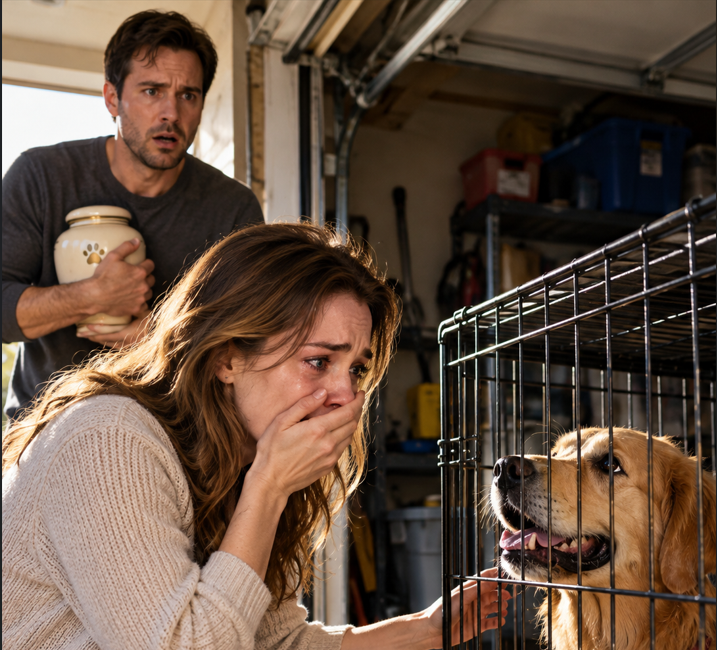
Mark was standing behind me in our mudroom, holding the little cream-colored urn he had given me when I got home.
For a moment, neither of us moved.
Then I heard it again.
Three quick scratches.
A pause.
And a low, familiar bark.
I turned toward him.
“Mark. What was that?”
He glanced at the door.
“Probably the neighbors’ dog.”
“From inside our garage?”
“Sounds travel, Natalie.”
I stared at him.
We had been married for eleven years. I knew when Mark was annoyed, when he was worried, and when he was trying to talk his way out of something.
This was different.
He was scared.
And I couldn’t understand why.
Six days earlier, while I was staying with my sister in Chicago, Mark had called to tell me that Daisy was dead.
Our Daisy.
The golden retriever we had adopted during our first year of marriage.
The dog who followed me into every room, stole socks from the laundry basket, and slept beside our bed even though Mark had spent ten years insisting she should sleep downstairs.
“She just collapsed,” he’d told me over the phone.
“What do you mean, collapsed?”
“I took her to the vet. They couldn’t save her.”
I remembered sitting on my sister’s kitchen floor because my legs suddenly wouldn’t hold me.
“Which vet?”
“The usual place.”
“Was she hurting?”
“Natalie, please. I can’t do this right now.”
I had assumed he was grieving too.
Now I wasn’t sure what I’d been hearing in his voice.
I’d been away for eight days to help my sister, and my flight home had changed at the last minute. Mark wasn’t expecting me until the following morning.
When I walked into our house, he looked startled.
Not pleasantly surprised.
Startled.
Then he hugged me.
There was a small urn sitting on the kitchen counter.
“She’s home,” he’d said quietly.
I couldn’t bring myself to touch it at first.
The idea that ten years of Daisy could fit inside something smaller than a coffee mug made me feel sick.
Eventually, I picked it up.
The ceramic was cool against my palms.
“Did you stay with her?” I asked.
Mark looked toward the window.
“I told you. Everything happened fast.”
“Did you bring her blanket?”
He shook his head.
“Sweetheart, can we not go through every detail?”
I tried to understand.
People handled grief differently.
That was what I kept telling myself.
But something about the house felt wrong.
Daisy’s water bowl wasn’t in its usual spot beside the refrigerator.
Her leash was missing from the hook near the back door.
And when I asked Mark where he’d put her favorite blanket, he said he’d already packed everything away.
“Seeing her things was too hard,” he explained.
I believed him.
At least, I wanted to.
I had spent most of the afternoon moving through the house like a visitor.
Every little sound made me expect to see Daisy appear around a corner.
When I dropped my suitcase, I waited for the familiar jingle of her brass tag.
Nothing.
When I opened the refrigerator, I almost called her name.
Nothing.
Then, while I was carrying laundry toward the mudroom, I heard scratching.
Three short strokes against something hard.
It stopped when I stopped walking.
I stood there listening.
“Mark?”
He appeared almost immediately.
“What?”
“Did you hear that?”
“Hear what?”
Another scratch.
He looked past me toward the garage.
“It’s probably something outside.”
I took a step toward the door.
He moved in front of me.
“Leave it.”
“Why?”
“Because I said so.”
That was when I noticed the urn in his hands.
He must have picked it up from the counter when he followed me.
He held it tightly against his chest, as if having it there settled the matter.
“Mark, move.”
“Natalie, you’re exhausted. You just got off a plane.”
“I’m not asking whether I’m tired.”
“You’re hearing things because you miss her.”
For a second, that hurt worse than anything else.
Because he knew how much I missed Daisy.
He knew I had cried myself to sleep at my sister’s house.
He knew I’d spent the flight staring at pictures of a dog I thought I’d never see again.
And he was standing there telling me I couldn’t trust my own ears.
I looked down at the garage door.
Something scraped against the other side.
Then came a small metallic rattle.
A sound I knew.
Daisy used to make it when her collar tag bumped against her food bowl.
My chest tightened.
“Open the door,” I said.
“There’s nothing in there.”
“Then open it.”
He didn’t move.
Instead, he reached toward my arm.
“You’re making yourself upset over nothing.”
I stepped away from his hand.
“Which veterinary clinic took care of Daisy?”
He blinked.
“What?”
“You said you took her to the vet. Which clinic?”
“Natalie—”
“Was it the one on McKnight Road?”
He looked down at the urn.
“I handled it.”
“That’s not what I asked.”
His jaw tightened.
I realized then that he had never actually told me which veterinarian had seen Daisy.
Or when she had been cremated.
Every time I’d asked, he’d found a reason not to answer.
And now he was doing it again.
A sudden bark came from the garage.
One short, sharp bark, followed by another.
I felt the blood rush to my face.
There were dozens of dogs in our neighborhood.
But I knew that bark.
Daisy made that exact sound whenever she heard me come home and couldn’t reach me.
“Move,” I whispered.
Mark shook his head.
“Don’t do this.”
“Move.”
“Natalie, listen to me.”
I pushed past him.
My fingers closed around the brass door handle.
Behind me, Mark raised his voice.
“Don’t open that door. Daisy’s gone!”
I turned the handle and pulled.
The door swung inward.
For half a second, all I could see was the concrete garage floor, the storage shelves, and the afternoon sunlight coming through the narrow side window.
Then something moved.
A golden head lifted inside a large metal pet crate a few feet from the doorway.
Two brown eyes found mine.
The dog’s tail struck the side of the crate.
Once.
Twice.
A familiar brass tag jingled beneath her chin.
And there, around her neck, was the old red collar with the frayed edge I’d been meaning to replace for months.
“Daisy?”
Her ears lifted.
She let out a soft, excited whine.
It was her.
Not a dog that looked like her.
Not some trick of my imagination.
Daisy.
My Daisy.
Alive.
For a moment, I couldn’t make myself breathe.
She pressed her nose toward the bars, her tail still thumping against the metal.
I took one step toward her.
Then I remembered the urn.
I turned slowly.
Mark was standing exactly where I’d left him.
The little cream-colored container was still in his hands.
He wasn’t looking at Daisy.
He was looking at me.
I had spent six days grieving for a dog who was now standing alive less than ten feet away.
And the man I’d trusted for eleven years had let me believe every word of it.
I looked at the urn.
Then at my husband.
“Then whose ashes did you give me?”
Mark’s face went pale.
His fingers loosened.
The urn tilted in his trembling hands.
And he said nothing.
My Husband Said Our Golden Retriever Died While I Was in Chicago, but the Sound Behind the Garage Door Made Me Question Everything
Page 1 of 8
Related Posts




Leave a Reply

At Her Husband’s Awards Dinner, Claire’s Daughter Asked Her for Five Minutes
Part 1 - The Five-Minute Promise “Mom, don’t go. Give me five minutes.” Claire Harrison had already picked up her...
Read moreDetails