

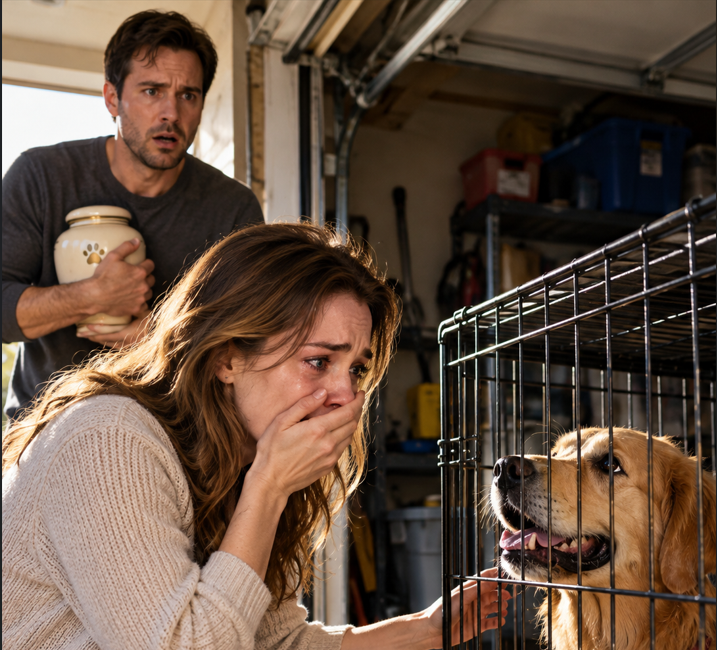
The first thing I did was put my hand on the crate latch. It was fastened with a sliding bolt, the kind we used when Daisy was a puppy and still believed every shoe in the house belonged to her. My fingers shook so badly that I missed the bolt twice.
“Don’t let her out yet,” Mark said behind me.
I turned. “Give me one reason. One real reason.”
“She’s been upset. I don’t know how she’ll react.”
Daisy’s tail was beating against the crate hard enough to make the metal ring. I opened it. She came straight into my arms, pushing her nose against my neck, her whole back end wagging. She smelled like the old dog shampoo I kept under the laundry sink. I buried my face in her fur and cried, although it wasn’t the same crying I’d done in Chicago. This time she was licking the tears away.
Her water bowl sat beside the crate, half full. A towel covered one corner. Someone had fed her; someone had also decided that she could spend the afternoon behind a locked door while I mourned her in the next room.
I stood, holding her collar. “The ashes, Mark.”
He set the urn on a shelf, carefully, as though it were still something sacred.
“They’re not anyone’s,” he said.
“What does that mean?”
“I filled it myself. Ash from the fire pit out back. It’s just ash.”
I had carried that thing against my chest. On the flight from Chicago I’d wondered whether there would be enough left of Daisy to scatter beneath the maple tree. All that time Mark had taken soot from the place where we burned fallen branches.
“Why?”
“I needed you to believe she’d died.”
“I understand that part. Why did you need it?”
He looked toward Daisy, who had found her missing leash in a basket under the shelving and was trying to drag it toward me.
“I was going to find her a new home,” he said.
I waited for the explanation that would make those words less monstrous. It didn’t come.
“You told me she’d died so you could give her away?”
“We need to make some changes, Natalie. Big changes. I didn’t know how to tell you.”
“You tell me by opening your mouth. Not by telling me our dog died.”
He rubbed his forehead. “I knew you’d say no.”
The honesty of that sentence was almost as awful as the lie. He hadn’t mistaken what I wanted. He’d understood it perfectly and decided I shouldn’t get a vote.
“Where was she for the last six days?”
“At a boarding place. Greenway Kennels, up near Wexford. I brought her home this afternoon.”
“To do what?”
“A family was supposed to pick her up tomorrow morning.”
I tightened my hold on the leash. “You were going to hand her over before I came home.”
Mark didn’t answer. He didn’t need to. My changed flight had ruined a schedule I hadn’t even known existed.
I took Daisy into the kitchen. She went to the familiar spot beside the refrigerator and looked up at me, waiting for water. Her old bowl wasn’t there. I found a stainless-steel mixing bowl, filled it, and placed it where hers had always been. She drank, then leaned against my leg. I ran a hand slowly over her back, feeling the familiar ridge of her spine and the warm movement of her breathing. I had spent the journey home wondering where I would put an urn so I could still feel close to her. Now she was alive, asking me to move so she could reach the crumbs beneath the counter. The relief was real, but it left no room for Mark to pretend the grief he had caused was harmless.
Mark followed me but kept to the doorway. “Please don’t call me cruel. I was trying to make this easier.”
“For whom?”
He opened his mouth, closed it, and looked away.
I picked up my phone and called the veterinary clinic on McKnight Road. Their receptionist knew Daisy by name. I asked whether any veterinarian had seen her in the past two weeks. After checking the records, she told me the last visit had been for routine blood work in May. She sounded confused when I explained why I was asking, and I did not make her listen to the whole story.
“Thank you,” I said. “She’s safe with me now.”
I hung up and told Mark what the clinic had said. He nodded once. There was nothing left for him to dispute.
“I want the boarding receipt, the messages about this family, and whatever else you’ve arranged,” I said. “Tonight.”
“Can’t we talk first?”
“We are talking. You’re not answering.”
I called my sister Rachel next. When she picked up, she asked whether I’d landed safely. I looked at Daisy, lying across my feet as if she could keep me from going anywhere again.
“Daisy’s alive,” I said.
There was a long silence. Then Rachel said, “Put me on speaker and tell me where you are.”
I didn’t put her on speaker. I went upstairs, packed a bag for two nights, and gathered Daisy’s medication, kibble, and blanket from the hall closet. The blanket was folded behind a stack of winter coats. Mark had not thrown it away. He had hidden it.
Before I carried out the last bag, I photographed a scrap of paper on the garage shelf. It held the name Lena Walsh, a telephone number, and the words Monday pickup. I needed to know who else had been told a story about my dog.
He watched while I carried everything to my car. We owned the house together; I wasn’t surrendering it by leaving for a night. I simply couldn’t sleep next to him while I learned what else he’d concealed.
“I love you,” he said from the front step.
“You knew how to reach me every day I was gone.”
“Natalie—”
“Don’t use my name like that.”
Daisy climbed onto the back seat with my help. She turned in a circle and settled on her blanket, exhausted. As I closed the door, my phone rang again. The screen showed an unfamiliar local number. I nearly ignored it, then answered.
“Hi, Natalie? This is June Morales with North Hills Realty,” a woman said. “Mark gave me your number. I’m confirming that we can still meet Monday about putting your house on the market.”
I looked across the driveway at my husband. He had gone very still.
“I’m sorry,” I told June. “What house?”