

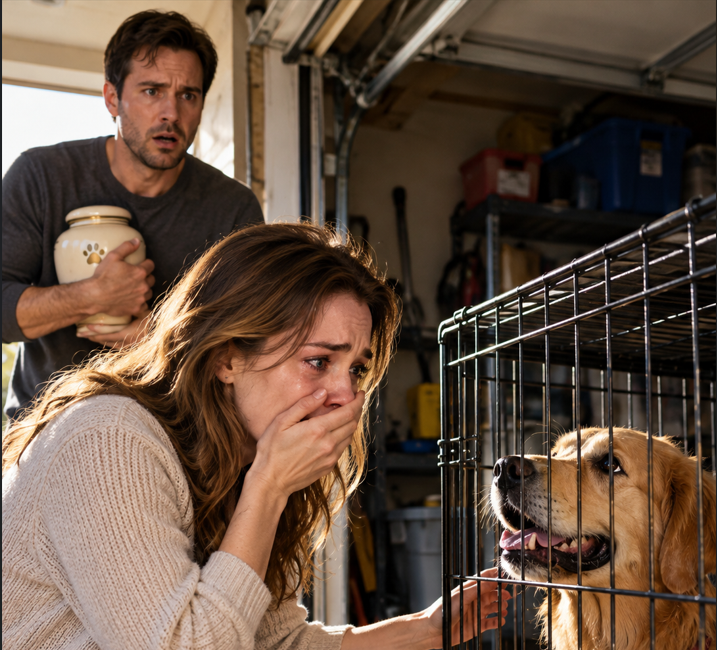
On Monday morning I drove Daisy to the veterinary clinic Mark had claimed was the last place she ever went. The receptionist came around the counter when she saw us, knelt beside Daisy, and scratched the white fur growing around her muzzle.
“You gave us a scare on the phone,” she said.
“I scared myself, too.”
Dr. Priya Shah examined Daisy while I explained what had happened. She checked her heart and joints, looked carefully at the skin beneath the red collar, and asked how long Daisy had been confined. I told her what I knew and admitted what I didn’t.
“She’s a little dehydrated and anxious, but I don’t see signs of an acute injury,” Dr. Shah said.
“Her arthritis is more noticeable than at her last visit. That doesn’t mean something happened this week; she’s getting older. Let’s make a plan for her comfort.”
She didn’t dramatize it. She gave me practical instructions: water, short walks, familiar routines, and a follow-up if Daisy stopped eating or showed pain. I wrote everything down. The small, ordinary fact that Daisy needed a measured walk rather than another miracle felt strangely comforting.
Before we left, I asked for a copy of her medical history. The clinic printed the records and confirmed that Daisy’s microchip was registered to me, with Mark as the secondary contact. I knew registration wasn’t a court ruling about ownership. Still, it mattered that my name hadn’t disappeared simply because Mark wanted it to.
I took Daisy to Tessa’s and drove to Greenway Kennels. Their manager, Carla Ruiz, met me in the lobby after I’d called ahead. I showed identification and Daisy’s records. Carla couldn’t disclose every internal note or private message, but she could discuss the boarding reservation made under my household’s name.
“Mark checked her in on Tuesday morning,” she said, pointing to the date on the invoice she’d been authorized to provide.
“He asked us not to contact the secondary owner. He said you were traveling and difficult to reach.”
Tuesday. Two days after I left for Chicago, the same day he called to say Daisy had collapsed. While I sat on Rachel’s kitchen floor, Daisy had been sleeping in a kennel with a blanket from home.
“Did he say she was ill?”
“No. He told us the family was moving. She ate normally and was friendly with the staff. We took her outside several times a day.”
A woman behind the glass door was throwing a rubber ball for three dogs in the exercise yard. I tried to hold on to that sight. Daisy had not spent six days trapped in the garage. At least someone had spoken kindly to her while I believed she was gone.
Carla lowered her voice. “He mentioned a private placement, not a rescue. When he picked her up early yesterday, he said he needed the crate for transport.”
She didn’t know who was supposed to take Daisy next. Neither did I, yet. At home I’d found only Mark’s explanation and a phone number for a family he said was coming in the morning. I wrote it down without calling immediately. I wanted to know exactly what he’d promised them before bringing another person into this.
That afternoon I met Dana Brooks, the attorney Rachel had helped me find. Her office was above a bakery in a strip of old storefronts north of Pittsburgh. I arrived with a folder thick enough to make me feel foolish until Dana began turning the pages.
She asked about our income, house title, accounts, and the business transfers. I told her I wanted to protect myself, not punish Mark for things I hadn’t verified. She nodded.
“Then we start with a complete financial picture,” she said.
“Your options depend on whose names are on the debts, how funds were used, and what you both decide next. Don’t assume a lender can take your home tomorrow, but don’t ignore notices either.”
She recommended obtaining statements directly from each account, checking our credit reports, and documenting any proposed agreement before transferring large sums. She also suggested that Mark provide a full accounting through counsel if we could not do it cooperatively. I left with tasks, not promises.
Mark had been texting since breakfast, asking to meet. I agreed to speak that evening in a quiet coffee shop. Tessa offered to come, but I asked her to wait nearby instead. I wanted to hear him without an audience and leave whenever I needed.
He arrived wearing the same navy work jacket he used to wear to the office. For eleven years I’d watched him pull it on before leaving each morning. Seeing it now made my stomach turn.
“When did you lose your job?” I asked as soon as he sat down.
He stared into his untouched coffee. “Late May. They cut my position.”
“It’s September.”
“I thought I’d find another one before I had to tell you.”
“Where did you go every morning?”
“Interviews. Simon’s workshop. Sometimes I just drove.”
I thought about the mornings he’d kissed my forehead while I read the news, the messages he’d sent complaining about meetings that hadn’t happened. He’d built an entire workday for me to believe in.
“The money?” I asked.
“I thought the renovation contracts would pay it back. Simon needed equipment and insurance. I kept putting money in because stopping meant admitting it was gone.”
“Did you tell him you had permission to use our savings?”
“I told him it was my money to invest.”
“It was ours.”
He nodded, but he still didn’t look at me.
Then he explained the apartment he’d found in Columbus, where a construction firm had offered him a six-month project job. The lease allowed no large dogs. His plan had been to sell our house, move into temporary housing, and use part of the equity to clear what he’d lost. He’d imagined I would eventually agree, once the alternative felt frightening enough.
“And Daisy was the obstacle,” I said.
He whispered, “I told myself she would be happy with a family who had more room.”
“You never asked what would make me happy.”
I got up before he could answer. Outside, the sky had darkened and rain was beginning to spot the sidewalk. My phone buzzed as I reached the car. It was an email from June confirming that the listing file was closed.
For the first time since opening the garage door, something had happened because I said no, and the answer had held.