

The duplex looked smaller in person than it had online. The kitchen had room for one narrow table, and the living-room carpet was worn near the window. But the yard was enclosed, the bedroom was downstairs, and there was a maple tree at the edge of the property. When I opened the gate, Daisy stepped into the grass and began sniffing as if every leaf were a letter addressed to her.
The landlord, Mrs. Patel, watched from the porch.
“She seems comfortable here,” she said.
“She’s had a difficult few months.”
“Well, she’s welcome if you decide to take it. I ask for references and the usual pet deposit. Nothing unusual.”
I almost laughed at how much those last two words meant. There would be an application, a deposit, and a written lease. No sudden story about a death that hadn’t happened. I went home and filled out the forms.
Three days later June called with an offer on the house. It was a little below the asking price, and the buyers wanted an inspection. Mark and I considered the numbers separately with our advisers before agreeing on a counteroffer. The buyers accepted. The buyers wanted a January closing to coordinate with the end of their rental lease, which gave me time to move without rushing Daisy into an unfamiliar place. A sale could still fall through, but for the first time there was a possible closing date on the calendar.
I should have felt relieved. Instead I walked through our kitchen and cried because the chipped blue tile near the sink would soon belong to strangers. I’d picked that tile with Mark during our first year in the house, when money had been tight but we still made plans together. Knowing I needed to leave didn’t make every memory worthless. It only meant I couldn’t live inside the good ones and call that safety.
My mother phoned after Rachel told her we were separating. She worried about me living alone and asked whether Mark couldn’t simply admit his mistake and promise never to repeat it. I told her the outline of the story, including the week I believed Daisy was dead. She went quiet.
“I didn’t understand how much he planned,” she said at last.
“Neither did I.”
She didn’t bring up forgiveness again. Instead she asked whether I needed someone to pack the dishes. I said yes. In a family that sometimes avoided difficult subjects, that was its own kind of progress.
Dana arranged a meeting with Mark and his attorney to work through the financial settlement. By then the mortgage was current through payments we’d documented and agreed to account for later. Mark brought statements from the failed venture, including receipts for equipment purchases and a letter explaining which business assets had been sold. The records didn’t return the savings, but they showed where much of it had gone. He agreed that the portion he’d taken for his venture should be accounted for against his share of the house proceeds, subject to the final figures and our attorneys’ review.
He’d started the project job in Columbus and was renting a small room there. It was temporary, he said, and not an invitation for me to follow. He looked thinner, though I couldn’t tell whether that came from stress or from the hours he was working. The change in his appearance stirred a familiarity I wasn’t prepared for. Eleven years together doesn’t evaporate because a marriage breaks. I still knew how he held a pen and which questions made him rub his jaw.
When the lawyers finished, Mark asked whether we could speak alone in the conference room for a few minutes. Dana checked that I was comfortable with it. I said yes, leaving the door open.
“I owe you more than a financial explanation,” he said.
I sat across from him. “Then don’t give me another version where you had no choice.”
He looked down at his hands. “I had choices. I chose the ones that kept you from knowing how badly I’d failed.”
“When I called from Chicago and asked if Daisy was hurting, what were you thinking?”
His throat moved. “That you’d ask for the vet’s name again. I’d already checked her into Greenway. I knew I couldn’t answer if you kept asking questions.”
“So you made me stop.”
“Yes.”
“And later, when I said I couldn’t sleep because I missed her?”
“I should have told you then.”
“You could have told me any of those six days.”
“I know.”
He didn’t add an excuse. I appreciated that more than I wanted to, but appreciation wasn’t the same as trust.
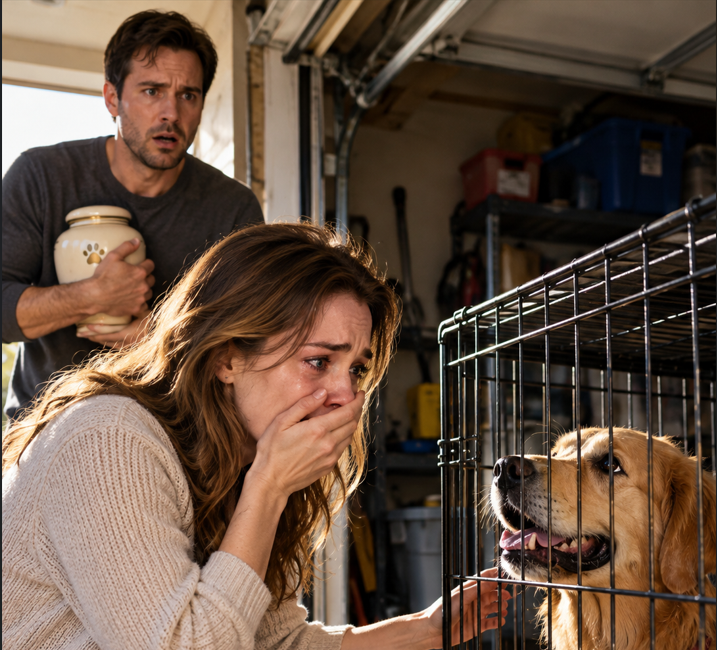
“I keep thinking about how you held that urn,” I said.
“You knew what was inside it, and you let me think I was holding Daisy.”
He closed his eyes. “I was ashamed of what I’d done. Then every day made it harder to admit.”
“That’s the part I can’t get past. Every day was another chance to stop hurting me. You were there for all of them.”
Mark wiped his eyes with the heel of his hand. “Do you think there’s any chance for us? Not now. Maybe someday.”
I looked out the window at the bakery sign across the street. For weeks I’d rehearsed answers to that question, some angry and some gentle. None of them felt right until I imagined going to bed again beside a man who had insisted I couldn’t trust the sounds I heard with my own ears.
“I can’t build a marriage around checking whether you’re telling me the truth,” I said.
“I believe you’re sorry. I don’t want to come back.”
He nodded. His sadness was real; so was mine. Neither changed my answer.
At home that evening, Daisy was waiting beside Tessa’s gate. When I knelt to greet her, she leaned her heavy head into my shoulder. I held her for a minute before going inside to sign the duplex lease. I had spent so long responding to what Mark had already decided that making a choice for myself still felt unfamiliar. This one was small enough to fit on a few pages, and large enough to change the rest of my life.