

I asked Arthur to meet me at the rescue on Saturday morning.
He arrived ten minutes early carrying a folder, a water bottle for Cooper and an old leash that he’d washed but never thrown away.
I brought the blue collar, our adoption papers and the dog himself.
Teresa welcomed us into a quiet room away from the kennels.
She had reviewed the microchip records, Rebecca’s surrender documents and the county shelter’s transfer history.
None of it answered every question about the seven years between Arthur’s recovery and Cooper’s arrival at the rescue.
The surviving records showed several placements, but there were long stretches nobody could reconstruct reliably.
“We don’t have to make up a story for the missing years,” Teresa said.
“We know enough to make a careful decision about the years ahead.”
Arthur looked at me, waiting.
“I’d like to try him living with you,” I said.
“Not as a surprise move today. A gradual change, with a plan for his care and a way for us to check how he’s doing.”
Arthur pressed his lips together.
“I don’t know how to thank you.”
“You don’t need to thank me yet,” I said, attempting a smile.
“He may decide your kitchen needs remodeling.”
Arthur laughed, and Cooper lifted his head at the sound.
It was the first time I’d heard the old man laugh without sadness in it.
Teresa helped us write down an arrangement we could both understand.
For the next two weeks, Cooper would spend longer daytime visits at Arthur’s house, then three trial nights there.
I’d visit regularly, and we’d record his appetite, sleep, comfort and willingness to settle.
Dr. Park would review the plan if he showed signs of stress or worsening arthritis.
If the transition went well, I would voluntarily complete the paperwork to transfer his adoption ownership and update his microchip registration.
We made another decision before leaving the rescue.
I would remain Cooper’s regular backup caregiver if Arthur became ill or needed help.
Arthur would remain responsible for routine veterinary care once the transfer was complete, and we would agree on a schedule of visits that wouldn’t disrupt the dog’s rest.
We put the details on paper because affection alone wouldn’t make us reliable.
Rebecca offered to pay for a new orthopedic bed.
Arthur thanked her but asked her to discuss any future help with him rather than arranging things behind his back.
She agreed.
They had begun speaking again, cautiously, but neither pretended the lost years could be returned with a purchase.
The first trial night was harder on me than on Cooper.
I carried his blanket into Arthur’s kitchen, set it beside the soft mat and placed his food bowl near the refrigerator.
He sniffed everything, circled twice and settled down.
“He’s okay,” Arthur said.
I nodded.
At the door, Cooper got up and came over to me.
My throat closed as I crouched and scratched behind his ears.
“I’ll see you tomorrow, buddy.”
He licked my wrist, then turned when Arthur called from the kitchen.
There was no dramatic choice between us.
Just a tired old dog responding to two familiar voices.
I drove home and parked outside my own house.
Through the front window I could see the empty spot beside my bedroom door.
For three weeks that place had belonged to Cooper.
I hadn’t realized how quickly a small routine could become part of a life.
I cried while washing his spare food bowl.
Not because I regretted bringing Arthur into his life.
I cried because making the right decision didn’t mean I wouldn’t miss him.
On the second morning, Arthur sent a photograph.
Cooper was stretched in a square of sunlight near the kitchen window, his white paw resting over the edge of his blanket.
Underneath, Arthur had written, “He slept through the night. Ate breakfast. Waiting for his walk.”
We followed the trial plan without rushing it.
Some days Cooper preferred short strolls.
Other days he stood at the gate, waiting for one of us to clip on his leash.
He continued to recognize my car and greeted me with the same gentle excitement he’d shown at my house.
At Arthur’s, he started sleeping in the kitchen every night.
Dr. Park examined him after the trial and found no new medical concerns.
At the end of the month, I signed the transfer documents with Teresa present.
Arthur updated the microchip contact information, listing me as an emergency contact with my consent.
The rescue retained the records so nobody would have to guess at his history again.
Arthur asked whether I wanted to take the blue collar home as a keepsake.
I shook my head.
“Let him keep it,” I said.
“It belongs to this part of his life too.”
A few days later, Rebecca joined us for a walk around the library.
Arthur hadn’t forgiven her in some sudden, perfect way.
He still asked hard questions, and she answered them without trying to shorten the conversation.
I thought that was a beginning worth protecting.
The seasons changed.
I continued visiting twice a week, sometimes bringing groceries for Arthur and sometimes just sitting on his porch while Cooper slept between our chairs.
When Arthur had a medical appointment, Cooper spent the afternoon at my place and returned home that evening.
The arrangement became ordinary, which was precisely what we’d hoped.
One afternoon Arthur showed me the lake photograph again.
He placed it beside a new picture of the three of us in his yard.
In both photographs, the same white paw rested across someone’s shoe.
“I used to think I had to get back everything I lost,” Arthur said.
“But you gave him somewhere safe when I couldn’t.”
I looked down at the dog who had answered to two names and loved without asking us to explain either one.
“I didn’t lose him,” I said.
“I found out how many people a home can hold.”
Cooper raised his head at my voice.
Arthur said, “Scout?”
The dog wagged his tail.
I said, “Cooper?”
He wagged it again.
Then he closed his eyes, content to sleep between us.
[ THE END.]
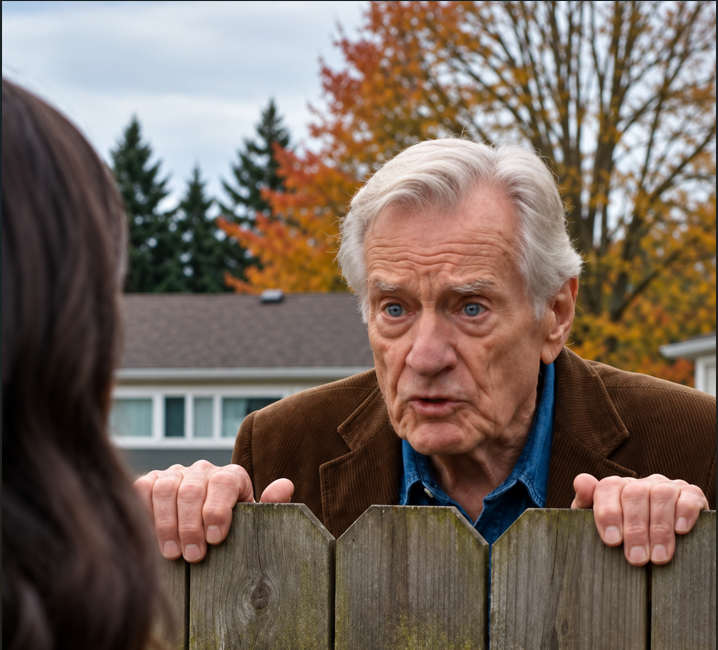
When an elderly man first stopped at my gate, I stood close to Cooper because I was afraid someone might take away the dog I’d just learned to love. I remember the worn photograph in his shaking hands, the little white paw, and the way my quiet old Labrador suddenly seemed to recognize a voice from another lifetime. I had always thought a rescue meant giving an animal a fresh start. I hadn’t considered that a fresh start could bring an unfinished past to my doorstep. The hardest part wasn’t opening the gate. It was admitting that love might ask me to leave it open.