

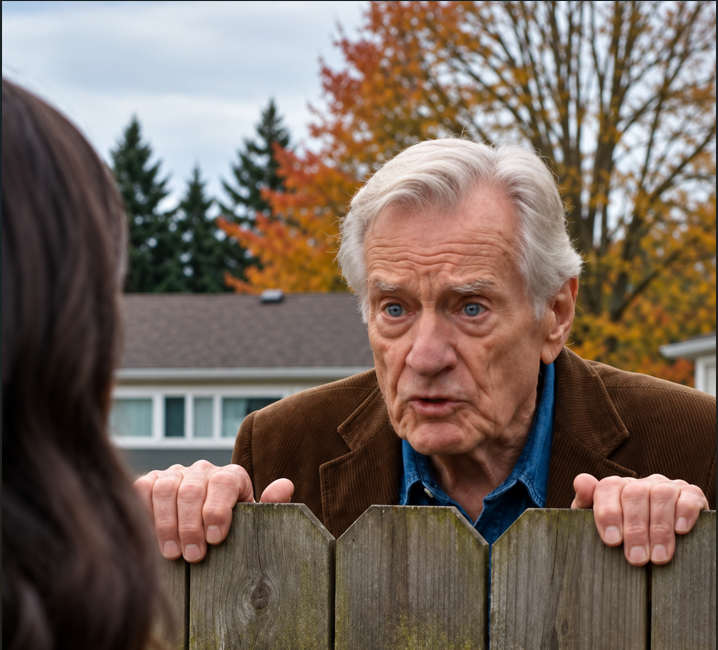
Arthur’s question stayed between us in the narrow entryway.
Behind him hung a row of empty coat hooks and a photograph of June beside the same lake shown in his wallet picture.
Cooper stood with his nose against the base of a closed door.
“He used to sleep in the kitchen,” Arthur explained.
“He always checked that door first.”
I looked at the dog, then at Arthur.
“I can’t make that decision this minute,” I said.
“I know.”
His answer came without hesitation.
He offered to show me the house, not as a sales pitch, but so I’d understand what he could provide.
The kitchen was tidy, with a nonslip runner stretching from the doorway to the table.
The yard was small, securely fenced and almost entirely level.
Arthur told me his physical therapist had helped him make the house safer after his stroke.
“I walk every day,” he said.
“I can manage him, but I’d want someone available if he got sick or I needed to go to the hospital.”
It wasn’t a foolish promise that nothing would ever happen.
He understood that care meant having a plan for when things went wrong.
I found myself respecting him more for it.
Cooper settled beneath the table, exactly where Arthur said Scout used to lie while June cooked.
Arthur stared at that patch of floor for several seconds.
Then he pulled out a chair for me.
“Could we try visits first?” he asked.
“I don’t want him frightened or confused. And I don’t want you to lose him overnight.”
I agreed to an afternoon visit two days later.
Until then, Cooper would stay with me and keep his familiar routine.
Arthur said he would buy the same food and ask Dr. Park about his joints.
We exchanged phone numbers and wrote down the rescue’s advice.
Rebecca was waiting on the sidewalk when I left.
She had parked across from the library but hadn’t come inside.
“I’m sorry for what I did,” she said.
“I’m not the person you need to tell first.”
“I know.”
She showed me a scanned copy of the old surrender agreement on her phone.
Scout’s description and approximate age matched, along with a note about his white paw.
The document listed a temporary-placement conversation with a boarding volunteer, but the signature authorized permanent transfer.
It explained how Scout had legally entered another home’s care, even though Arthur had never known.
“I kept telling myself I was protecting Dad,” Rebecca said.
“After a while I was just protecting myself from admitting what I’d done.”
I didn’t try to make her feel better.
I asked whether she’d give the full record to Arthur and the rescue.
She said yes.
That evening, Cooper ate his dinner, took his usual slow walk and slept beside my bedroom door.
I lay awake listening to his breathing.
I kept imagining the moment he had run toward Arthur, so unlike his ordinary greetings.
But I also remembered the afternoon he’d rested his head on my knee at the shelter.
That moment hadn’t become less real because another person had loved him first.
The first visit went smoothly.
Arthur was waiting with a bowl of water, a soft mat and a calendar where he’d written Cooper’s meal times.
I stayed for an hour.
Then I walked to the corner store, leaving them together for twenty minutes.
Arthur sent me a photograph of Cooper sleeping beneath the kitchen table.
“He’s doing fine,” the message said.
“So am I.”
When I returned, Cooper greeted me happily.
Then he went back to Arthur and nudged the old man’s hand.
Watching him move between us made something painfully clear.
He wasn’t choosing sides in the human argument that had formed around him.
He simply wanted the people he trusted to remain close.
We repeated the visit twice that week.
One afternoon I found Arthur sitting on the floor beside Cooper, checking the dog’s paw after he’d stepped awkwardly off the porch.
It was nothing serious, but Arthur had already called Dr. Park for guidance.
He had taken her advice and moved a small step stool away from the door.
“I made a mistake with him once,” he said.
“Not because I meant to, but because I wasn’t able to look after him. I want to be careful now.”
“You didn’t surrender him,” I said.
“I still have to think about what he needs today, not what I wish I’d had seven years ago.”
It was the most honest thing anyone had said since he appeared at my gate.
A week after the reunion, Rebecca came to one of the visits.
She brought the original paperwork and a short letter in which she took responsibility for the surrender and the false story she’d told.
Arthur accepted the documents but didn’t invite her to stay for dinner.
“I love you,” he told her at the door.
“But I need time before I can trust what you say.”
Rebecca nodded and left without arguing.
When she was gone, Arthur sat down heavily.
“I lost my wife,” he said.
“Then I thought I’d lost my dog. I never knew how much of my grief was built on a lie.”
I sat beside him.
I couldn’t repair what his daughter had done, and I couldn’t give him back those years.
I could only decide what I was willing to do with the years Cooper might still have.
That night Arthur called me.
His voice sounded steadier than it had on our first meeting.
“If he stays with you, I’ll understand,” he said.
“I need you to know that. You didn’t cause any of this.”
I looked at Cooper sleeping beside my couch.
His white paw twitched as he dreamed.
“And if he stays with you,” I answered, “I need to know I won’t become another person who disappears from his life.”
“You won’t,” Arthur said.
“Not if I can help it.”
After we hung up, I opened my adoption folder and set the papers on the table.
For the first time, I was ready to decide what being Cooper’s person actually required of me.
To see the promise Arthur and I finally made, continue with Part 5.