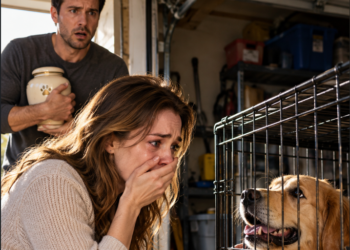


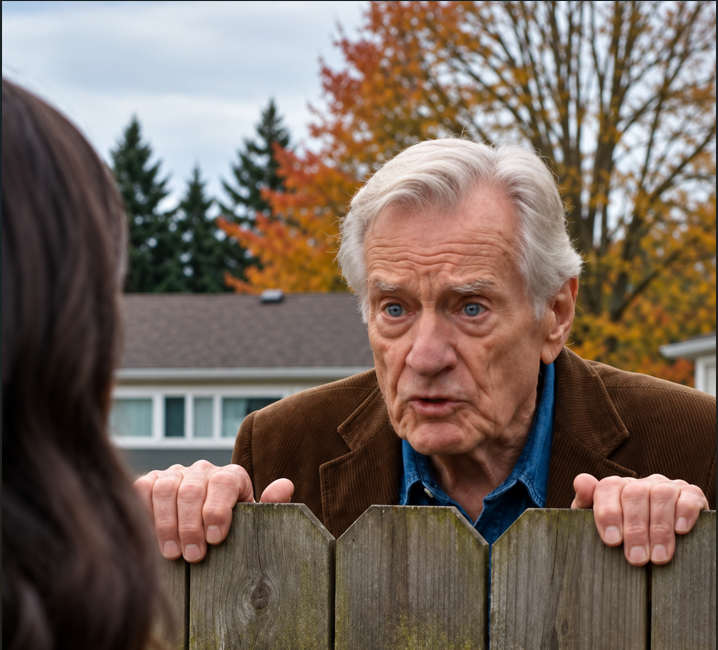
I invited Arthur onto the porch because his knees were trembling.
Cooper followed him as if a leash connected them, then settled with his chin across the man’s shoe.
The photograph lay between us on the little patio table.
“I know how this looks,” Arthur said.
“I don’t expect you to hand him over because an old man cried at your gate.”
“I’m glad you said that,” I answered.
“I love him, and I need to know what’s true.”
Arthur nodded without lifting his hand from Cooper’s back.
He told me he lived six blocks away, in a small house near the neighborhood library.
He had taken a different walking route that afternoon because construction had closed the sidewalk on his usual street.
“If I’d gone the other way, I never would have seen him.”
I asked about the seven years.
Arthur folded the photograph carefully, but he didn’t put it away.
“My wife, June, died the winter before Scout vanished,” he said.
“The house got very quiet. Scout was the reason I got up and went outside most mornings.”
He rubbed the dog’s white paw with one finger.
Then he explained that he’d suffered a stroke the following summer.
He had spent weeks in the hospital and months relearning how to walk without assistance.
His daughter, Rebecca, had taken charge of his bills, his house and Scout’s care.
“She told me he’d gotten loose while staying with someone,” Arthur said.
“First she said they were looking. Then she said he’d been hit by a car.”
“Did you see a report?”
“No. She said the people who found him had already taken care of everything.”
Arthur looked embarrassed by his own answer.
He said he’d been confused from medication and frightened of another stroke.
By the time he could leave the rehabilitation center, Rebecca insisted there was nothing left to investigate.
“I called shelters anyway,” he said.
“I kept his photograph in my wallet because I couldn’t make myself throw it out.”
I looked at Cooper sleeping against Arthur’s feet.
A dog reacting to an old name and a familiar face was compelling, but I knew mistaken reunions could happen.
I wasn’t prepared to turn his life upside down based on one photograph.
“We should call the shelter,” I said.
“And a veterinarian.”
Arthur straightened.
“You’d do that?”
“I want an answer as much as you do.”
I called the rescue where I’d adopted Cooper.
Teresa, the adoption coordinator, remembered him immediately.
She was surprised but careful when I described what had happened.
“He came to us through a county shelter farther south,” she said.
“They’d received him from a family that couldn’t keep him after an older relative became ill.”
“Do you know the family’s name?”
“That information isn’t mine to release casually. Let me look at the records we can share.”
I appreciated that she didn’t treat a stranger’s emotional claim as proof.
Teresa explained that the transfer file listed an old identification number, but the number hadn’t led the county shelter to a current owner.
The registration information might never have been completed, or it might have expired years earlier.
“Bring him to your vet for another scan,” she advised.
“Ask Mr. Hayes whether he has any medical records from when Scout was young.”
Arthur reached for his coat pocket.
“I have a box at home. Vaccinations, old receipts. I kept all of it.”
We agreed to meet at my veterinary clinic the next morning.
Before Arthur left, he asked if he could give Cooper a biscuit.
I fetched one from the kitchen and watched him break it into four smaller pieces, just as carefully as someone feeding a child.
“He used to eat too fast,” Arthur said.
“June made me promise to slow him down.”
Cooper took each piece gently.
When Arthur reached the gate, the dog rose and followed.
He didn’t try to bolt through it, but he stood there long after the old man had disappeared down the sidewalk.
That night I sat on the kitchen floor beside Cooper’s food bowl.
The shelter had given him a temporary name; I was the one who’d chosen Cooper.
Now I wondered how many names he’d heard between that lake photograph and my front yard.
“You can have more than one person who loves you,” I told him.
He placed his chin on my knee.
I wished I believed my own words as easily as he seemed to.
At nine the next morning, Arthur arrived at the clinic carrying a cardboard folder tied with string.
Inside were faded vaccination certificates, invoices from a veterinary practice that had since changed owners, and a photograph of Scout curled beside June’s chair.
I noticed a small notch in the fur near the dog’s right ear.
“He cut himself on a garden fence when he was little,” Arthur said.
“Nothing serious, but the hair never grew back quite right.”
Cooper had a pale mark in almost the same place.
The veterinarian, Dr. Nina Park, examined him while I held the leash.
She explained that photographs and old scars could support identification, but wouldn’t establish it by themselves.
She passed a scanner over his neck and shoulders.
It remained silent.
My stomach tightened.
Then she changed the angle, moved slowly along his upper back and stopped near his right shoulder blade.
A number appeared on the screen.
Arthur gripped the edge of the examination table.
Dr. Park wrote the number on a sheet of paper.
She didn’t read it aloud as a verdict.
“Let’s compare it with the original records,” she said.
Arthur opened his folder again.
He searched through the papers once, then twice.
At the bottom was a receipt showing Scout’s microchip had been implanted eight years earlier.
The printed number had faded, and the last digits were difficult to make out.
Dr. Park called the clinic named on the receipt and asked whether its archived records could be retrieved.
They promised to call back.
We were almost at the door when Arthur’s phone rang.
It was Rebecca.
He answered on speaker because his hands were full.
“Dad, where are you? You missed our morning call.”
“At a veterinary clinic,” he said.
“I may have found Scout.”
There was a silence so long I thought the connection had dropped.
Then Rebecca said, very quietly, “Dad, please don’t do this again.”
Arthur stared at the phone.
“What do you mean, again?”
“I need to talk to you before you look at any more records,” she replied.
She ended the call without answering his question.
For the first time since Arthur had appeared at my gate, I felt afraid that finding the dog’s identity might be only the beginning.
To understand why Rebecca was afraid of those records, continue with Part 3.