

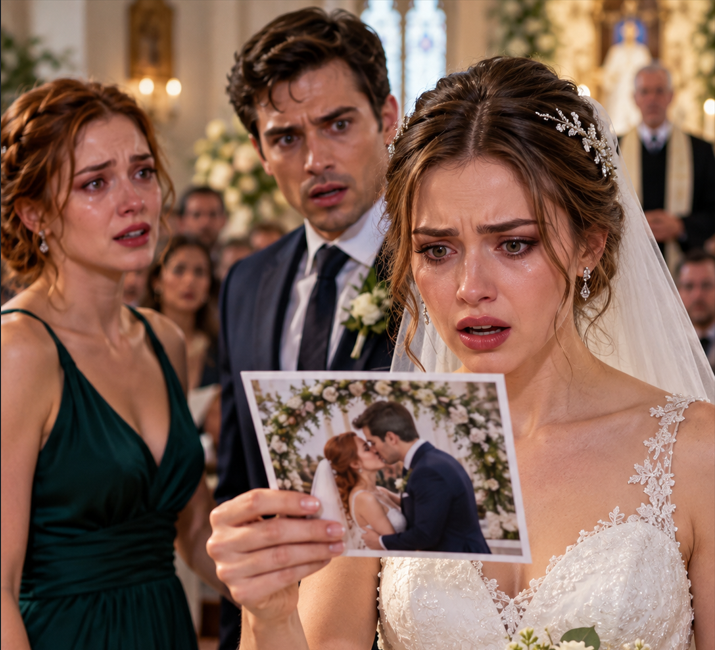
By the time I left the chapel, the caterer had called three times. Ryan had called nineteen. My phone screen was crowded with messages that ranged from Are you safe? to Please don’t let strangers tell you who I am. I turned it facedown in my father’s car and watched the city slide past the window.
I hadn’t gone home. Home was the apartment Ryan and I had rented together for three years, with his shoes by the door and our grocery list clipped to the refrigerator. My father took me to my parents’ house instead. Claire brought my overnight bag and a plastic garment cover to protect a dress I couldn’t bear to see.
That evening Hannah sent me three photographs and a scanned document. We had exchanged numbers in the dressing room, a small, practical decision I would later realize required more courage from her than I understood. I was the woman Ryan had publicly chosen to marry. She was his wife, suddenly afraid that the entire relationship she’d built had been a performance.
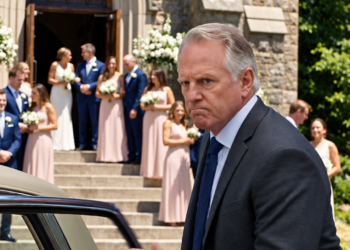
Her first photograph showed the ceremony at Willow Creek House near Fredericksburg, Virginia. Hannah’s parents were smiling beside a row of hydrangeas. Ryan stood with his arm around her waist. His mother, Diane, was on the other side of him. Mara stood behind them, holding a folded program.
I enlarged the picture until the faces blurred. Diane had told us she couldn’t travel to our wedding because of a lingering respiratory infection. She had sent a card with a handwritten apology. Less than a month before that, she had apparently been healthy enough to attend her son’s wedding to somebody else.
I called Hannah. “His mother was there.”
“Yes. I thought you knew.”
“She told me she was sick today.”
Hannah didn’t fill the silence with explanations. When she spoke, it was slowly.
“Ryan told Diane he’d broken up with someone earlier this year. I heard him say it at the rehearsal dinner. I thought he was talking about a woman from his past.”
The document was a copy of a Virginia marriage license and the completed certificate section, showing Ryan’s full name, Hannah’s name, the officiant, and a date twenty-seven days before our planned wedding. Hannah told me she had requested an official certified copy after finding my website; it hadn’t arrived yet. For now, I could see only what she was showing me, and I needed to be careful about the difference.
“How did you meet?” I asked.
“At a conference for commercial property managers in Charlottesville. He sold flooring systems to one of our buildings. We talked for hours after a vendor dinner. That was almost eighteen months ago.”
Eighteen months. Ryan had been engaged to me for nearly two years. In the same period that he helped me choose a reception menu, he’d been building a second relationship an hour away.
Hannah said he traveled often, sometimes for a week at a time. He stayed at her apartment, met her friends, helped her father repair a porch railing. He was thoughtful about small things: replacing the batteries in the smoke alarm, remembering the name of a neighbor’s dog, calling when she was sick. I knew those details because he’d been that man in my life, too.
“What did he say about his work schedule?” I asked.
“That the territory had expanded. His company’s headquarters needed him in Richmond a lot.”
I almost laughed. Richmond was where he lived with me. During the months he’d called Hannah from hotel lobbies, he’d sometimes been calling from our kitchen.
“I need you to know something,” Hannah said.
“I wasn’t trying to take him from you. I thought you were over.”
“I believe you.”
Saying it didn’t erase the sick ache in my stomach. It did, however, stop me from handing Ryan the one thing he seemed to want: two women blaming each other instead of comparing what he’d told them.
The next morning, I called the circuit court clerk’s office listed on the license. The woman who answered explained what their office could confirm and how requests for marriage records worked. She couldn’t discuss every detail of another person’s records over the phone, but she gave me the public instructions for requesting or verifying documents. Hannah, as a named party, would have access to a certified record through the proper process. I wrote everything down.
Then I called our wedding officiant. Reverend Porter spoke with extraordinary gentleness. He said no vows had been exchanged, he had solemnized no marriage between Ryan and me, and he would not submit any completion paperwork. I asked him to send a brief written confirmation. I needed the facts in front of me, especially the ones that would sound unbelievable in a month.
By noon Claire had picked up my essential belongings from the apartment while Ryan was away. She brought my laptop, passport, work files, medications, and the small box containing my grandmother’s letters. I told her not to move anything we jointly owned, and she photographed the condition of the apartment before leaving.
When we reviewed our shared expenses that night, I opened the banking app we used for wedding bills. Ryan and I had each deposited money into a joint checking account. I’d always checked whether there was enough to pay the next vendor, never the precise path of every withdrawal.
Three days before the wedding, an electronic transfer of $12,600 had gone out to an account held solely in Ryan’s name. He had labeled it Vendor reserve. I remembered him telling me he was moving money temporarily to qualify for a venue discount. The balance was supposed to come back after the reception.
I searched the account history. It hadn’t come back.
“Maybe he did pay someone with it,” Claire said cautiously.
“Maybe.”
I printed the statement rather than guessing. Then I checked the linked card we’d used for household expenses. Five weeks earlier, a charge for $4,800 appeared under a company name I didn’t recognize: Willow Creek House Events.
I held the card statement next to Hannah’s photographs. I knew the name of the place now. It was printed on the wedding program behind Mara’s shoulder.
Ryan had not only hidden another wedding from me. He appeared to have used money from our shared life to help pay for it. And this time the question wasn’t what I could make him admit in a crowded chapel. It was what the records would show when he wasn’t there to answer for them.