

By morning, Abigail knew that silence had become too expensive, even if the proposed payment would have made everything else easier.
She called Priya before the deadline and asked her to reject the agreement as written.
“I don’t want to pretend I don’t need help,” Abigail said.
“I just don’t want the help to cost me the truth.”
Priya sent a response that afternoon.
It said Abigail remained open to a lawful resolution of lost wages, medical costs, and employment concerns, but she would not sign a false description of the assault or withdraw her account.
There was no insult in the letter and no demand for a public spectacle.
Only a clear statement of what was not for sale.
The Sinclair office did not answer immediately.
For three days, Abigail checked her email more often than she wanted to admit.
She bought groceries with a calculator open on her phone and postponed ordering the crib mattress.
At night, she wondered whether she’d made the wrong choice.
During that time, the hotel investigation moved forward.
Helen interviewed servers, musicians, security personnel, and supervisors who had worked the gala.
Jenna’s statement supported the recording.
The access log showed that Abigail had not entered or approved the disputed form, while management staff had processed it after the sponsor’s office demanded a quick resolution.
Claire admitted that she had forwarded the request to her team without questioning whether the supposed employee acknowledgment existed.
She had been worried about losing a valuable event contract.
The hotel’s management had to answer for that decision separately from Vanessa’s conduct.
A week after the meeting, Helen called Abigail and Priya together.
The hotel had completed its initial findings and would provide them with a written summary.
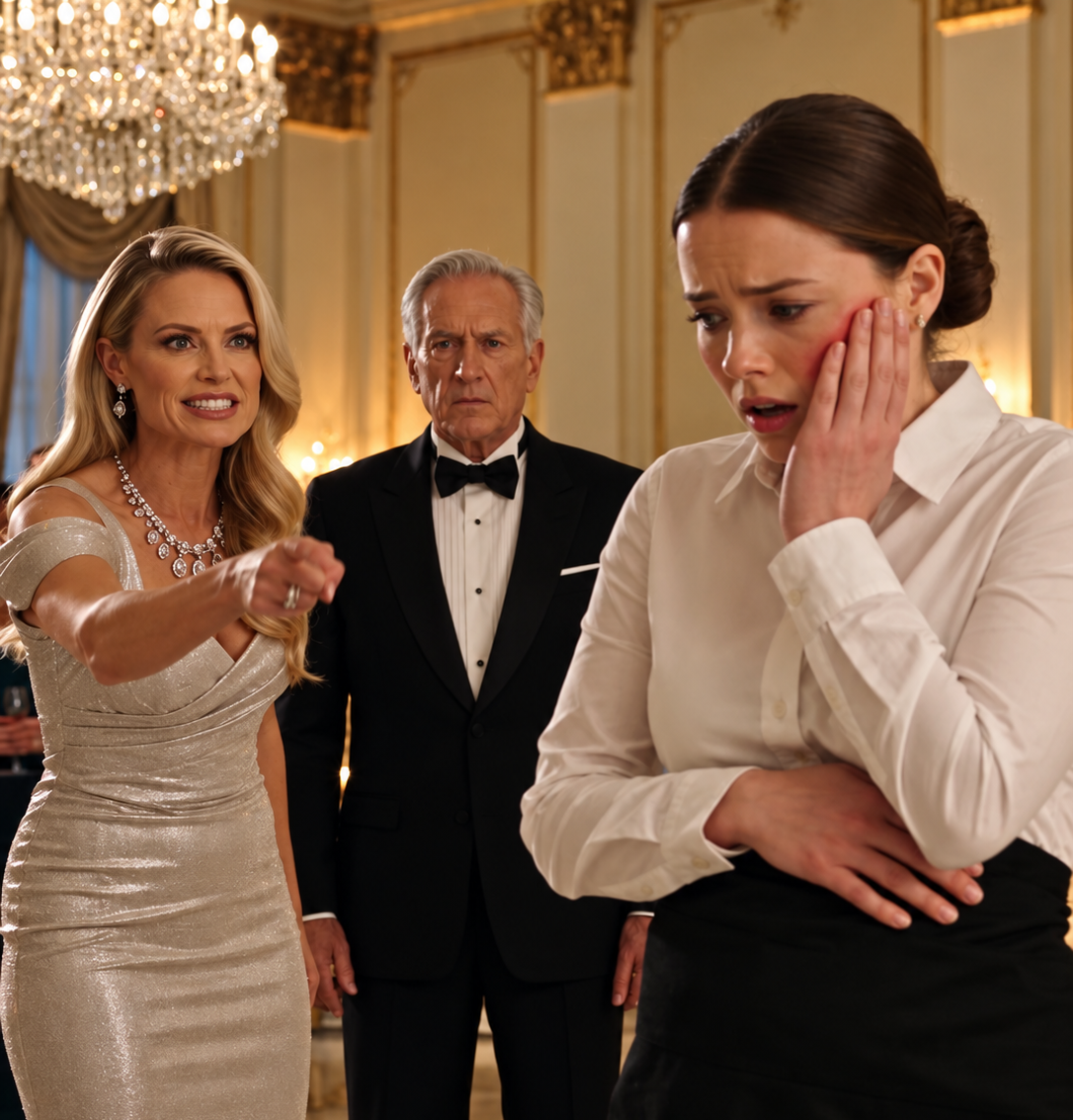
It acknowledged that Vanessa had struck Abigail before the tray fell and that Abigail had not authorized the portal acknowledgment.
The document was permanently voided, and her employee file would contain a correction.
The hotel also agreed to pay for the scheduled shifts Abigail had missed during the disputed suspension period.
It offered to reimburse the medical evaluation and arranged an accommodation review for the remainder of her pregnancy.
Those measures did not require a statement excusing Vanessa or a promise to stay silent.
“This should have happened without a fight,” Abigail said when she read the letter.
“It should have,” Helen answered.
The manager responsible for processing the inaccurate form was removed from incident-reporting duties while the hotel reviewed its controls.
Employees would now receive a copy of any acknowledgment attributed to them and a direct way to challenge mistakes without going through the supervisor involved.
Abigail didn’t mistake those measures for perfection.
But Jenna called that night to say the staff finally knew where they could report misconduct by a guest.
The police report remained open for review, and Priya explained that any further legal process would take its own course.
Abigail understood that a recorded slap did not make every consequence happen overnight.
She had learned to distinguish proof from a promise of justice.
Richard Sinclair eventually sent her a letter through his attorney.
He acknowledged that his office had pressured the hotel to close the incident prematurely and that the pressure was wrong.
He said he would not seek to interfere with the hotel’s findings.
His letter did not ask for forgiveness.
Abigail kept it with the other records, because an admission in writing was more useful to her than an elaborate speech.
Vanessa sent nothing.
She no longer served as the public chair of the Sinclair Foundation’s gala committee after its board reviewed what happened, although Abigail had no interest in following every change to her social calendar.
What mattered was that the slap would no longer be recorded as an accident caused by an employee.
Matteo visited her apartment one Saturday with Isabella, after asking first.
He arrived without an entourage and looked slightly uncomfortable holding a box of replacement shelf brackets Isabella had asked him to bring.
The three of them assembled the crib Abigail had finally ordered.
“I’ve negotiated shipping contracts worth more than this building,” Matteo said after attaching one rail backward.
“Apparently that doesn’t qualify me to follow six pages of instructions.”
“You could try reading page two,” Abigail replied.
Isabella laughed so hard she had to sit on the floor.
The ordinary afternoon did more to ease Abigail’s embarrassment about receiving help than any grand gesture could have done.
No one mentioned the photograph of Matteo kneeling in the ballroom.
Later, Isabella asked whether Abigail would allow her to visit after the baby was born.
“As a friend?” Abigail asked.
“I was hoping so.”
“Then yes. But bring groceries, not photographers.”
Isabella promised.
Matteo waited until his sister was in the kitchen before speaking quietly to Abigail.
“For years, I imagined finding you and making some extraordinary repayment,” he said.
“I didn’t expect to find you on a night when someone else needed to be told to behave decently.”
“You don’t owe me eight years of gratitude,” Abigail replied.
“Your sister survived. That was enough.”
“It wasn’t enough for me to stop looking.”
She understood the difference now.
He had wanted to find a person from an important memory, not to purchase control over her present life.
After a conversation with her obstetrician and the hotel, Abigail accepted a temporary desk-based assignment and a written plan for leave around the birth.
She stayed employed while deciding what she wanted next.
She also enrolled in one evening bookkeeping course for the following term, a small ambition she had delayed while working unpredictable banquet shifts.
Two months after the gala, she gave birth to a healthy baby girl.
She named her Lucy, a name she’d chosen long before Matteo Romano walked into her life.
Isabella visited at the hospital with flowers and the groceries she’d promised, then asked permission before lifting the baby from the bassinet.
“She’s so small,” Isabella whispered.
“She gets louder,” Abigail said.
“Give her an hour.”
They laughed together beside the window.
Matteo waited in the hallway until Abigail invited him in.
He offered his congratulations and stood awkwardly at the foot of the bed while Lucy slept.
“Are you going to ask to hold her?” Abigail said.
“Only if you’re comfortable with that.”
“Sit down first. You look as though you’re about to negotiate a treaty.”
He sat, and she showed him how to support Lucy’s head.
There was no camera, no audience, and no donor table waiting for a photograph.
That night, when the visitors had gone, Abigail studied the little hospital bracelet around Lucy’s wrist.
Eight years earlier, another young woman had worn a bracelet in another hospital while Abigail sat beside her, promising only to stay until the doctors came.
Abigail hadn’t known that the memory would return to her in such an unlikely place.
She was grateful for the friendship it had brought, but even more grateful that she had not let anybody else decide what her own story meant.
[ THE END.]
When Abigail remembered the Grand Atoria, she did not first think about its chandeliers or the famous guests who had watched her work. She remembered the sound of broken glass and the strange weight of an employee badge lying at her feet. She had been afraid of losing a paycheck, afraid for her baby, and almost more afraid to insist that what happened had happened. Somewhere in that crowded ballroom, a man had knelt to pick up her name. But the question that stayed with her was why so many people had stood still when she needed someone to speak.