

The first person to ask whether Abigail needed a chair was Isabella.
She pulled one away from a nearby table while Matteo signaled for the orchestra to remain silent.
Abigail sat because her knees had begun to shake, not because she wanted to become the center of another spectacle.
“Are you hurt anywhere besides your face?” Isabella asked.
“I don’t think so.”
Abigail looked at the fragments of crystal still scattered near her shoes.
“I need to tell my supervisor what happened.”
“You need someone to check on you,” Isabella said.
“Everything else can wait.”
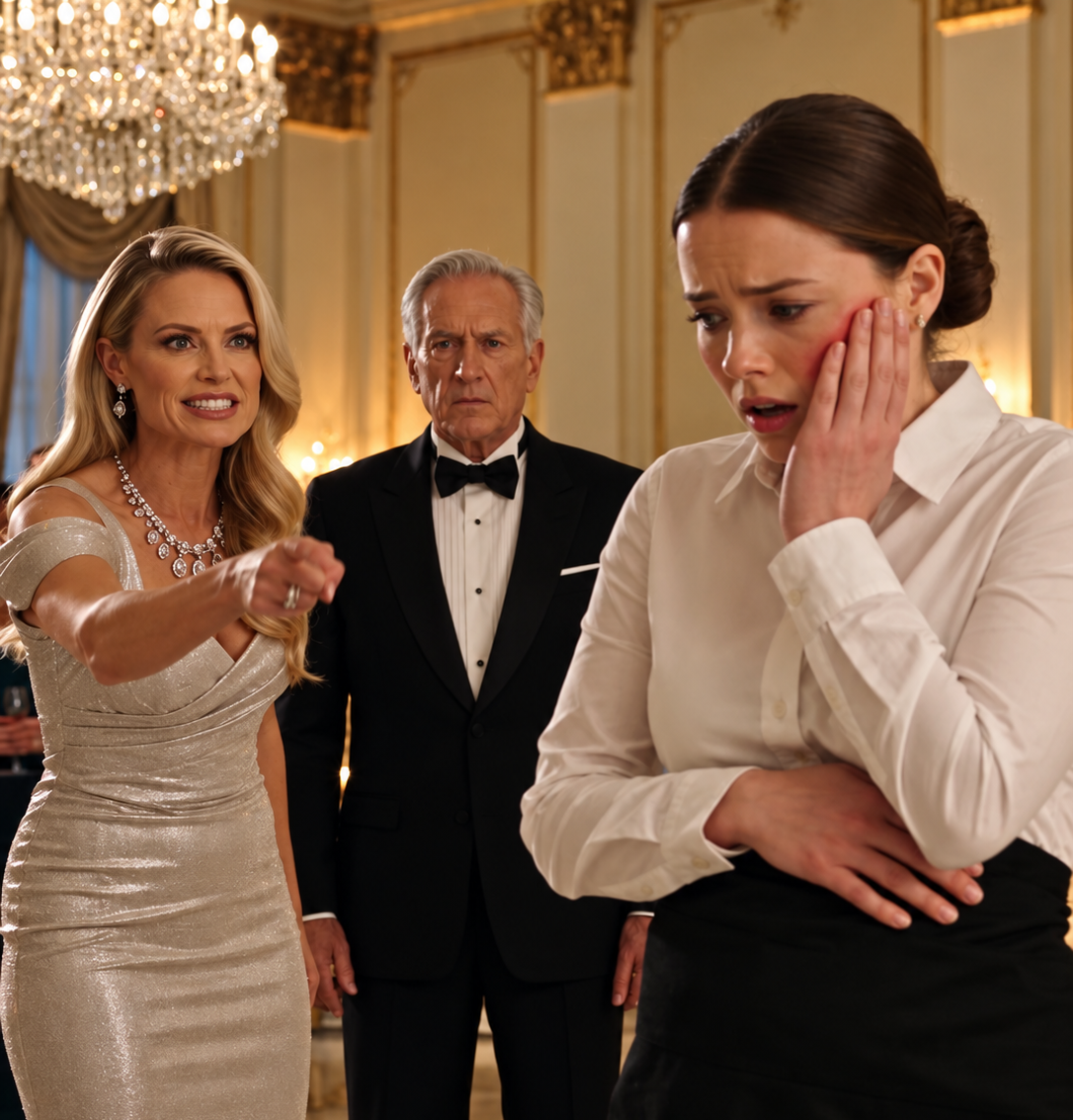
Vanessa gave a sharp sigh.
“Are we really going to pretend this was an attack? She dropped a tray.”
Matteo turned toward her.
“You hit her. Those are two separate events.”
Richard stepped between them, careful to keep his expression composed for the cameras.
“My daughter behaved poorly,” he said.
“We’ll make amends, and the evening can continue.”
“Not on my behalf,” Abigail answered.
Richard appeared startled that she had spoken directly to him.
“Excuse me?”
“Please don’t tell people I’ve accepted an apology. I haven’t received one.”
For the first time since the slap, Vanessa looked at Abigail rather than through her.
A woman wearing a Grand Atoria management badge hurried toward them.
Her name was Claire Benton, the hotel’s director of banquet operations.
She had interviewed Abigail six months earlier and approved her request for shorter shifts as the pregnancy progressed.
“Abigail, come with me,” Claire said.
“We have a private room downstairs.”
Abigail stood carefully.
“Is this about my job?”
“It’s about making sure you’re all right.”
“Then I’d like that written down.”
Claire’s face tightened, although she agreed.
Isabella offered to accompany them, and Abigail accepted.
Matteo stayed behind long enough to ask the head of security to preserve the ballroom recordings and the incident logs.
He made the request in front of two witnesses, then followed at a distance.
In a small conference room behind the service corridor, Abigail finally saw her cheek in a mirror.
The swelling was unmistakable.
She photographed it with her phone, then wrote the time of the incident on the back of a catering schedule.
Claire placed a glass of water before her.
“We’d prefer to keep this from becoming a bigger issue,” she said.
“It’s already an issue,” Abigail replied.
Claire glanced at Isabella, as though a billionaire’s sister were an improper person to hear an employment conversation.
“Abigail, there are procedures.”
“Then please follow them.”
A hotel medic checked Abigail’s pulse and recommended a medical evaluation because she was pregnant and had stumbled.
The doctor at the hospital later found no immediate signs of injury to the pregnancy, but asked Abigail to return if she had pain, bleeding, or reduced fetal movement.
Abigail listened carefully.
She had worked too many extra shifts to risk ignoring those instructions.
Matteo offered to have his driver take her home after the appointment.
“I can take a cab,” she said.
“Of course. I’m sorry. I keep trying to solve things before asking what you want.”
The admission surprised her more than his offer.
She accepted the ride only after Isabella suggested coming along.
During the trip, Isabella spoke about the accident in fragments: the rain, the metal against the windshield, the long weeks of rehabilitation.
Abigail remembered almost none of the medical details.
She remembered a frightened girl gripping her hand.
“I was nineteen,” Abigail said.
“I had gone to the hospital with a friend who was giving blood. They were asking for compatible donors.”
“You gave more than that,” Isabella replied.
“You stayed when I was afraid.”
At her apartment building in Queens, Abigail insisted on walking to the entrance without an audience.
Matteo asked if he could contact her once, in a few days, and handed her a card rather than demanding her number.
“Your sister has mine,” Abigail told him.
“She can ask whether I’d like to talk.”
He nodded.
Upstairs, Abigail removed her aching shoes and checked the balance on her bank account.
The numbers were unchanged by the night’s astonishing reunion.
Her landlord would still expect the rent on the first.
Her baby would still need diapers and a safe place to sleep.
And someone had slapped her at work in front of a room full of people who had done nothing.
She wrote down everything she remembered while it was fresh, including the words Vanessa had used and the names of guests standing nearby.
Then she sent a short email to Claire requesting an incident report and confirmation that her next shift remained scheduled.
By morning, her phone was full of messages.
A photograph of Matteo kneeling beside her had spread across social media.
Most captions called him a hero.
Several didn’t mention Abigail by name.
One account described her as a clumsy server who had been rescued from an embarrassing mistake.
Abigail turned the phone facedown.
At eleven, Claire finally replied.
The hotel was placing her shifts on hold while it reviewed the disruption to the gala.
She would be paid for the evening, but nothing in the message promised payment beyond that.
Abigail called immediately.
“Am I suspended?”
“We’re conducting a review,” Claire said.
“Please don’t discuss the matter publicly.”
“I’m asking whether I’m still employed.”
“Someone from human resources will contact you.”
The call ended without an answer.
An hour later, an unfamiliar document appeared in her employee portal.
It was labeled EMPLOYEE INCIDENT ACKNOWLEDGMENT.
According to the form, Abigail had admitted that she had acted carelessly, that no intentional physical contact had occurred, and that she considered the matter resolved.
At the bottom was a digital signature bearing her name.
Abigail had never seen the form before.
She had certainly never signed it.
She enlarged the screen until the words blurred at the edges.
The document wasn’t merely inaccurate.
Someone had begun rewriting what happened in the ballroom, and had used her name to do it.
Who had signed for her? Continue with Part 3 to uncover the record Abigail refused to let disappear.