

Mom came to the house an hour before the hearing.
She parked across the street, walked up the front path without her purse, and stood under the porch light even though it was morning.
Grandma watched her through the window.
“Let her in,” she said.
“Are you sure?”
“I asked to hear her.”
Mom stopped just inside the doorway when she saw the changed locks.
Her eyes moved to the family photographs still hanging in the hall, then to Grandma in the kitchen.
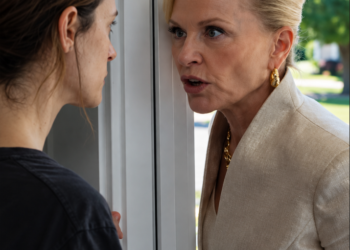
“Eleanor, I’m so sorry this got out of hand.”
Grandma didn’t offer her a chair.
“Which part are you sorry for?”
Mom looked at me.
“Can we talk privately?”
“No,” Grandma said. “Ivan stays. He’s heard enough lies without having to wonder what you told me afterward.”
Mom folded her hands together.
“Arthur’s business was going under. He owed suppliers, taxes, and a lender who was threatening to seize equipment. We thought if we could use the house for a short time, he’d have room to breathe.”
“Use it how?” Grandma asked.
“As security for a loan. Or sell it and buy you a smaller place. Arthur kept changing the plan.”
“And where would I live while you decided?”
“We found a care facility.”
“You found a place to put me,” Grandma said. “You didn’t ask if I wanted to go.”
Mom’s eyes filled.
“We were afraid you’d refuse.”
The kitchen went quiet.
Grandma rested both hands on the back of her chair.
“Of course I might have refused. It was my house.”
Mom wiped at her cheek.
“I signed the closing instructions because Arthur said the deed was already taken care of. I didn’t sign the deed itself. I thought we’d be able to explain afterward.”
“Did you know I hadn’t agreed?”
Mom’s gaze dropped.
“Yes.”
“Did you know your husband took fifty-five thousand dollars from my accounts?”
“I knew money was moving. I didn’t know the full amount until he showed me the numbers.”
“When?”
“Before we took you to the facility.”
I felt the last excuse I’d been making for her disappear.
She had not misunderstood after the fact.
She had known enough to stop and had chosen to keep going.
“Why did you leave her in the lobby?” I asked.
“The administrator wanted to speak to Eleanor alone and asked questions about whether she had agreed to stay. Arthur said we needed to get documents from the car. He panicked.”
“And you left with him.”
She nodded.
“I kept telling myself we’d come back.”
Grandma pulled out a chair then, but she sat in it herself.
“I spent most of my life believing that if people were frightened enough, they might forget to be decent. But you had a long drive to that facility. You had time to turn around. You had time to tell me the truth.”
Mom began crying in earnest.
“Please don’t make this the end of our family.”
Grandma looked exhausted, but her voice stayed even.
“You made decisions about my family without me. Today, I’m making one for myself. Leave the house, Wendy. Rebecca will handle the papers.”
Mom looked toward me, hoping I might object.
I opened the door.
She went out without saying another word.
At the courthouse, the hearing took less time than I’d expected.
There was no dramatic confession from Dad, no judge immediately announcing that Grandma had won everything back.
Rebecca presented the disputed recorded deed, Grandma’s sworn account, the therapy appointment record, the money transfers, and evidence that the property was being marketed while Grandma objected.
Dad’s attorney argued that Arthur had been acting out of concern and that the transfer was part of emergency financial planning.
The judge did not decide the entire case that morning.
He granted temporary restrictions on further sale or transfer while the parties prepared for additional proceedings, subject to the court’s order and later review.
It was a narrow protection, not a final victory.
But when Rebecca explained it to Grandma outside the courtroom, she closed her eyes and said, “Then I can sleep in my house tonight.”
I had expected the months afterward to feel like one long battle.
Instead, they were a collection of ordinary tasks made painful by the reason they had become necessary.
Grandma repeated her account to an adult protective services investigator, who listened to her wishes and worked with her on a safety plan.
She answered the bank’s questions, attended appointments with Rebecca, and authorized the release of her medical and therapy records.
I sat beside her when she wanted company and left the room when she preferred privacy.
The bank’s investigation led to the recovery of the twenty-five thousand dollars still held in the disputed escrow account.
A further eight thousand was recovered from an account associated with Briar Creek.
The remaining transfers had been spent or moved, and Rebecca pursued an accounting and repayment claim for that balance.
During the legal investigation, the notary whose name appeared on the deed was questioned.
She acknowledged that Grandma had never appeared before her.
Arthur had brought her a document he said his mother had already signed, and she had completed an acknowledgment she should never have made.
Her account, along with the therapy records and the examination of the original document, undermined the assertion that Grandma had signed the deed before her.
Authorities separately reviewed the notary’s conduct.
When Dad’s lawyers received that evidence, their position changed.
They stopped claiming that Grandma had personally authorized the transfer and began discussing a settlement that would undo the deed and address the missing funds.
The process took months.
Grandma refused to sign anything until Rebecca had read every page with her and explained exactly what rights she would be keeping.
Eventually, the parties entered a court-approved resolution that set aside the disputed transfer and restored the property record to reflect Grandma’s ownership.
The financial claims produced a judgment and repayment arrangement for the outstanding funds.
By then, the authorities had also opened a criminal investigation into the forged paperwork and misuse of her accounts.
Dad later accepted responsibility through a plea agreement on charges connected to the fraudulent transaction, with restitution obligations and a sentence imposed by the court.
Wendy faced separate civil consequences for her documented role in arranging the attempted sale.
The law did not put our family back together, and it did not return every dollar immediately.
It did make it harder for anyone to pretend that nothing wrong had happened.
One afternoon, nearly seven months after the day at the nursing facility, I found Grandma on the porch with a home-care worker who had come to help with the heavier household tasks.
Grandma was giving detailed instructions about her garden pots.
“Those need morning sun, not afternoon,” she said.
The worker laughed and moved them without argument.
Grandma had chosen the service herself, interviewed the person who came into her home, and set the days she wanted assistance.
She still used a cane on bad knee days, but she no longer apologized when she needed to sit down.
We had also repaired the front lock, put the albums back on the shelf, and found the oak cabinet in Dad’s storage unit after it appeared in the inventory prepared for the case.
It went beneath Grandpa’s photograph again.
Grandma left the faint rectangle on the wall unpainted for a while.
“I’m not ready to cover it,” she told me.
I understood.
Some absences should be acknowledged before anyone rushes to decorate over them.
I had moved no closer than I could afford to, but I visited on a regular schedule, and we spoke by phone on the evenings she liked.
Sometimes she asked about my work, sometimes about what I’d cooked, and sometimes she told me to stop worrying and get some sleep.
Not once did she ask me to take over her bank account.
That was how I knew we were helping each other without repeating what had happened.
Dad sent letters through his attorney and later a short personal note asking whether they might speak.
Grandma read it, folded it, and put it in the drawer with the other correspondence.
“Are you going to answer?” I asked.
“Not today.”
“Do you think you ever will?”
“That’s a decision I don’t owe anyone in advance.”
Mom sent a birthday card with no return address.
Grandma put that in the drawer too.
She didn’t burn it or display it.
She simply refused to let a card decide what forgiveness ought to mean.
On the first cool Saturday of the following autumn, I helped Grandma sort the remaining papers in Grandpa’s old desk.
We found receipts for fence repairs, instructions for the water heater, and the small envelope marked HOUSE DEED.
The words were still as familiar as they’d been when she pulled it from her coat in my car.
“Did Grandpa tell you to keep it hidden?” I asked.
“No,” she said. “He was just careful about paperwork. He wrote labels so we could find what we needed.”
For a moment, I almost laughed.
I had spent months imagining the envelope as a secret message from someone who’d foreseen the betrayal.
In reality, it was an ordinary act of care from a man who expected the woman he loved to be able to find her own documents.
Grandma slid the deed into a newly organized folder.
“What will you do with the house someday?” I asked.
“Maybe sell it when the stairs become too much. Maybe not. I’d like to have a few more ordinary Sundays here before I decide.”
I looked out toward the porch where I’d once watched my father carry groceries up those same steps.
The memory still hurt.
I could love parts of my childhood and admit that the adults who shaped it had done something unforgivable.
Both things were true, and neither erased the other.
Grandma placed the folder back in the drawer and turned the key.
“Would you put the kettle on, sweetheart?” she asked.
I did.
Outside, the neighborhood carried on: a lawn mower starting, a car door closing, somebody calling a dog home.
Grandma sat at her own kitchen table and chose which tea she wanted.
There was no grand announcement.
No one was waiting to tell her she was wrong.
For the first time in a long while, that ordinary choice felt like enough.
[ THE END.]
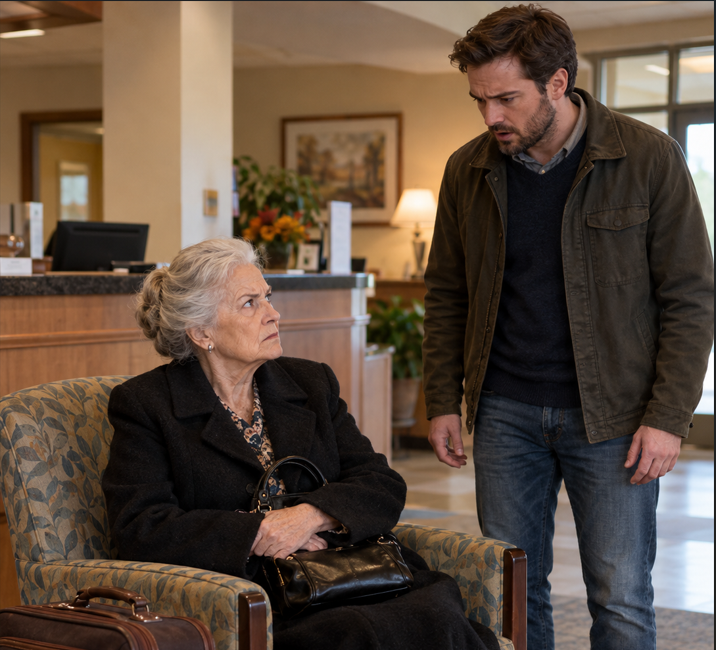
I still remember the brown suitcase beside a chair in a nursing home lobby, and the way my grandmother stood when she saw me. I had always assumed that the loudest person in our family knew the most, so I’d learned to accept my father’s explanations before asking her what she wanted. I think about the folded bank statement, her church coat, and the small envelope my grandfather had labeled years before anyone questioned where she belonged. The hardest part wasn’t realizing that people I trusted could lie. It was noticing how often I had let their certainty speak over her quiet answers.