

The road to the courthouse ran past a row of shuttered shops and a gas station where Grandpa used to buy peppermint candies for me.
I had driven it a hundred times growing up, usually with my father behind the wheel and Grandma reminding him not to take the turns too fast.
Now she sat beside me with the envelope held carefully in her lap, and I had no idea which of us was more afraid of what we might find.
“Grandpa wrote that?” I asked.
“Years ago. After we paid off the mortgage.”
“What’s inside?”
“The deed we kept with our important papers. And the recording information.”
“Then the house is yours.”
“It was the last time I checked.”
She didn’t say it sarcastically.
That was what made the words worse.
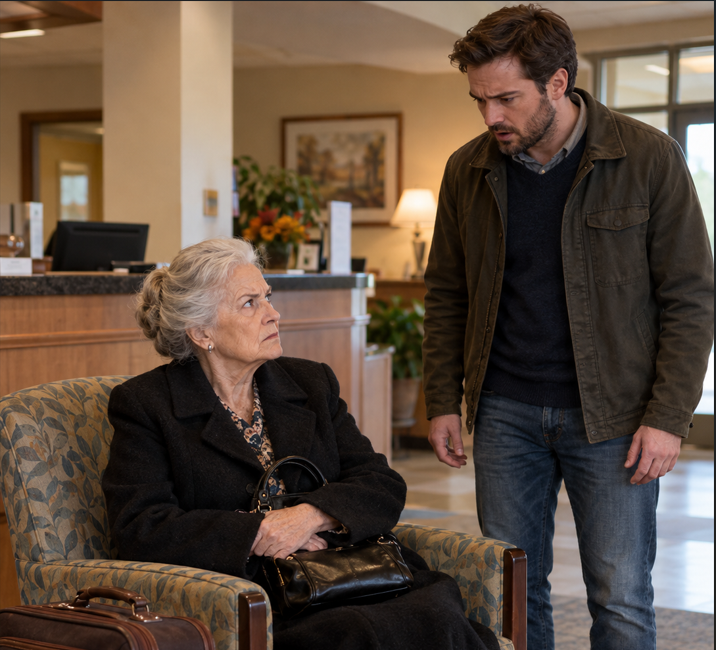
We reached the county administration building shortly before the recorder’s office closed.
Grandma walked slowly from the parking lot, one hand on my forearm, but she refused my offer to carry her purse.
At the counter, a clerk named Ms. Bennett asked what records we needed.
“The most recent deed recorded for my property,” Grandma said, and gave her address.
Ms. Bennett looked from the address to Grandma’s face.
“Are you the owner?”
“I believe I am. I’d like to find out whether anyone has tried to change that.”
The clerk didn’t react to the implication.
She turned her monitor slightly, searched the public index, and printed a list of recorded instruments.
The last entry was dated six days earlier.
I recognized Grandma’s name under the line marked grantor.
The grantee was an entity called Briar Creek Property Holdings LLC.
For a moment, the name meant nothing to me.
Then Grandma touched the paper with one finger.
“I didn’t sign a deed six days ago.”
Ms. Bennett’s expression grew careful.
“This office records documents submitted to us. Recording doesn’t mean we’ve verified that the signature is genuine.”
“Can we get a copy?” I asked.
She printed it and slid it across the counter.
A transfer deed occupied the first page, followed by a notarial acknowledgment.
The document claimed Grandma had signed voluntarily, transferring her house to the company for a stated consideration of ten dollars and other valuable consideration.
The signature at the bottom looked almost like hers.
Almost.
Grandma leaned closer.
“I cross my capital E the other way. My hand hasn’t made a loop like that since the arthritis got worse.”
“Could Dad sign it under the power of attorney?” I asked.
“An agent might sign a properly authorized deed in a disclosed capacity,” Ms. Bennett said, “but that’s not what this document says. It presents the signature as hers. You need a lawyer to review it.”
Grandma read the date again.
“That afternoon I was at physical therapy.”
“Are you sure?”
“I remember because the therapist made me practice stairs and I complained about it all evening.”
The acknowledgment claimed she’d appeared before a notary named Lydia Marsh at two fifteen.
Grandma said her therapy appointment had lasted until nearly three.
It wasn’t proof by itself, but it was a place to begin.
I looked at the page again, hoping I had misread something simple.
Then I noticed the address beneath the company name.
It was an office mailbox in the same shopping center where my father had rented space for his contracting business.
“Dad knows this place.”
“Arthur knows many places,” Grandma replied. “Let’s find out what this one means.”
We paid for certified copies and took photographs of the index entry.
Ms. Bennett gave us the number for the county bar association’s lawyer referral line and told us the recorder’s office couldn’t cancel a deed simply because someone disputed it.
I appreciated the honesty, even though I wanted her to pull the document out of the system and tear it in half.
In the hallway, Grandma stopped at a bench.
She wasn’t winded from the walk alone.
Her hands were shaking now, and she seemed angry with herself for letting me see.
“We can rest,” I said.
“I gave your father a key to my checkbook, not permission to hand my house to strangers.”
“Maybe the company belongs to somebody who was helping him.”
“Does that make it better?”
“No.”
I sat next to her.
For the first time, I understood that I had been asking questions as though there might be a version of this in which no one had betrayed her.
Grandma had already passed that point.
My phone displayed four missed calls from Dad and two from Mom.
There was also a message.
“Where are you? Bring Mom back before five. We have arrangements in place.”
I showed Grandma.
She read it without moving her lips.
“Don’t answer yet,” she said.
“Why before five?”
“I suspect we’ll see.”
The bank branch was ten minutes away.
It was still open, and Grandma insisted on going inside rather than using the drive-through.
At the customer service desk, she introduced herself, presented her identification, and asked to speak privately to the branch manager about possible unauthorized transactions by her agent.
A woman named Denise Carter took us into a small office.
She offered water, waited while Grandma settled into a chair, and addressed her directly.
That small courtesy nearly undid me.
“I want to understand what happened to my money,” Grandma said. “I also want my son’s authority over these accounts stopped.”
Denise asked to see the power of attorney on file.
It had been signed after Grandma’s knee surgery.
The document authorized Arthur to manage certain accounts and pay expenses while she recovered, but it didn’t appoint him as a guardian or transfer ownership of her money.
The branch had been accepting his instructions as her authorized agent.
“Can you show us the three transactions?” Grandma asked.
Denise reviewed the account history with her, verified details through the bank’s internal records, and printed the transaction references Grandma was entitled to receive.
The twelve-thousand-dollar transfer had gone to Sterling Home Services, the business Dad had kept alive long after it stopped earning much.
The eighteen thousand had gone to Briar Creek Property Holdings LLC.
The twenty-five thousand had gone to an escrow account handled by a title service company.
“The one connected to the deed?” I asked.
“We don’t know that from these records alone,” Denise said. “But we can flag the transactions for investigation.”
Grandma studied the papers.
“None of these people cared for me. Nobody provided fifty-five thousand dollars of care.”
Denise didn’t disagree, and she didn’t promise to recover the money immediately.
She explained the bank’s process for reporting suspected financial exploitation, reviewing withdrawals, and placing additional controls on the accounts.
Because Grandma was there, alert, and requesting the change herself, the bank could begin removing Arthur’s access under its procedures and help her open an account with new credentials.
They also gave her information about preparing a formal revocation of the power of attorney with legal counsel and notifying anyone else who might be relying on it.
“I don’t want Ivan to have the account instead,” Grandma said before anyone suggested it.
“That wasn’t my intention,” I said.
“I know. But I want my own money to remain my own.”
Denise nodded.
“Then we’ll work with you directly.”
I watched Grandma sign the bank’s paperwork, slowly but with a steady hand.
The same hand someone had apparently imitated on a house deed.
When we left, Dad called again.
This time Grandma said I could put him on speaker, but she held up a finger before I answered.
“Don’t tell him what we know.”
I pressed the button.
“Ivan, thank God. Where is she?” Dad demanded.
“She’s with me. She’s safe.”
“You had no right to take her out of that facility.”
“She asked me to.”
“She can’t make decisions like this on her own right now.”
Grandma reached toward the phone.
“Arthur, I can hear you perfectly well.”
There was a silence.
“Mom. We were trying to help you.”
“Then you should have stayed long enough to explain what you were doing.”
“The administrator misunderstood the arrangement,” he said.
I remembered the woman telling me they had left without completing admission paperwork.
I wondered how an administrator could misunderstand two adults walking out and never returning.
“Where are you?” he asked again.
“Out with my grandson,” Grandma said. “We’ll speak when I’m ready.”
“Don’t go to your house,” Dad said quickly.
That was the first answer I believed he’d given all day.
“Why?” Grandma asked.
“Because I’m arranging some work there. I don’t want you getting upset about things you don’t understand.”
Grandma stared through the windshield.
“I understand my address, Arthur.”
He exhaled sharply.
“Please. Just let me explain.”
“You’ve had plenty of opportunities.”
She ended the call herself.
As we drove toward her neighborhood, she took a photograph from the envelope and showed it to me.
Grandpa stood in front of the house beside a younger Grandma, both of them holding paintbrushes.
He’d written a date on the back from the summer they repaired the porch.
“We worked every weekend because we couldn’t afford to hire anyone,” she said.
I had known the house was important to her.
I hadn’t understood how much of her life she’d poured into keeping it.
When we turned onto her street, a white vehicle was parked at the curb.
A woman with a camera was taking pictures of the front steps.
Beside her stood a real estate agent holding a clipboard.
Grandma stared at them.
“I didn’t ask anyone to sell my house.”
The agent looked up as I stopped the car.
He lifted his hand, smiled politely, and walked toward us.
“Are you here for the five o’clock walk-through?” he asked.
I turned off the engine.
Grandma opened her door before I could answer.
To see who had arranged strangers to inspect her home, continue with Part 3.