

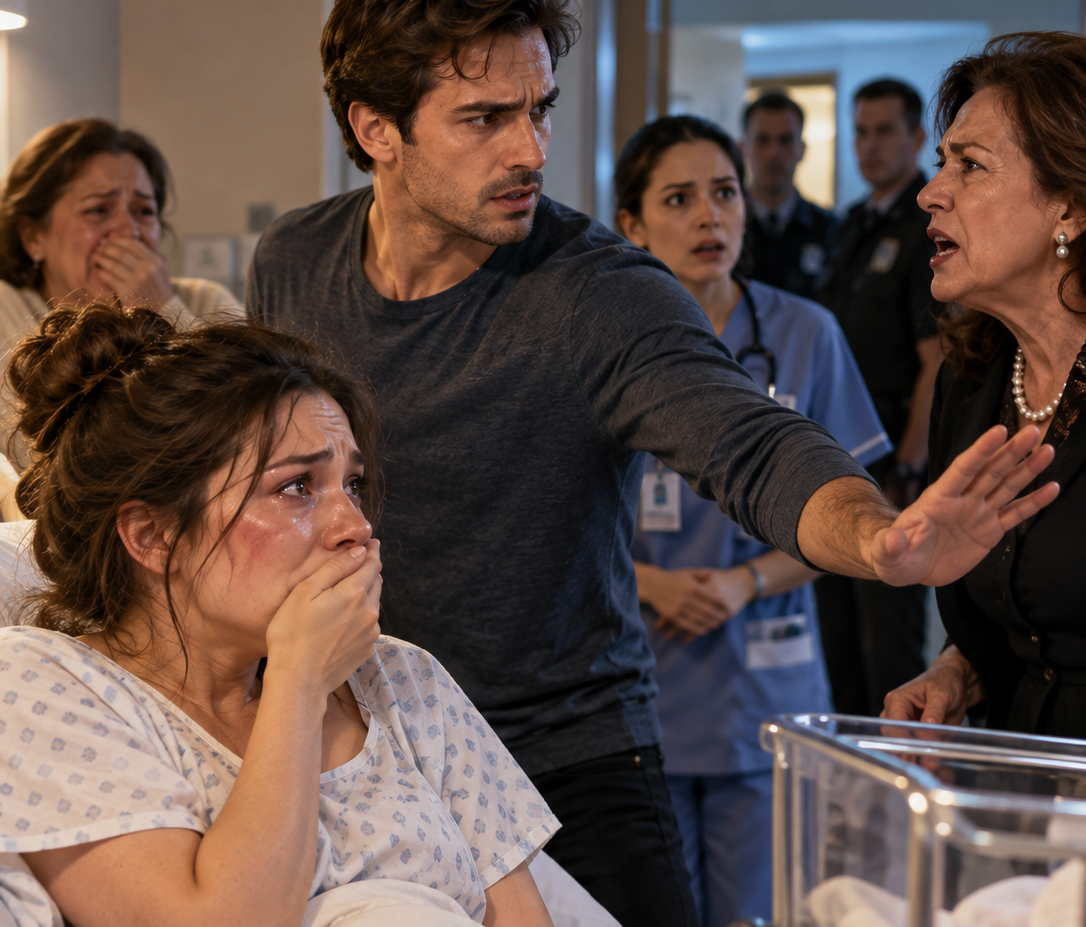
The security officers did not rush in aggressively. One stayed near the doorway while the other spoke quietly with the charge nurse for a few seconds. Somehow, their calm made everything feel more real.
Until then, a part of me had still been hoping someone would say the whole thing was an impossible nightmare caused by exhaustion, medication, and the blur of giving birth.
Instead, I watched the nurse point to the stained blanket, the used gauze, and the small specimen container where they had saved a sample of the substance.
“Ma’am, you need to leave the room,” one of the officers told my mother-in-law.
She stared at him in disbelief.
“I’m the grandmother.”
“Then you should have been protecting the baby.”
Andrew said nothing. When the officer asked him to confirm his name, hearing it spoken out loud made the situation feel strange and formal all at once.
Andrew looked paler than I did. He was still holding my hand, but his fingers had gone rigid.
His mother turned to him.
“Andrew, tell them this is a misunderstanding.”
He finally looked at her.
“It’s not a misunderstanding if our son was covered in something while Emily was asleep.”
Hearing my own name made me feel like myself again for the first time since waking up.
My mother, Theresa, sat in a chair near the window. She had stopped crying. She kept staring at the palm of the hand she had used to hit me.
I could not tell whether she was ashamed of what she had done or afraid of what might happen because of it. At that moment, I did not have the energy to find out.
The charge nurse explained that a pediatrician would examine our son and that the hospital would document everything as a precaution. Then she asked whether I wanted the relatives removed from the room.
“Yes.”
I did not even look at them.
One of my uncles opened his mouth, maybe to apologize, but Andrew cut in first.
“You heard Emily.”
The door closed behind them.
For the first time since I woke up, the room held only me, Andrew, and medical staff.
When they brought our baby back, he was clean.
His skin was pink, slightly flushed at the cheeks, and a small lock of dark hair stuck to his forehead. The pediatrician said he was breathing normally and showed no visible irritation in his eyes or mouth. They planned to keep observing him, but at that point there were no signs of acute injury.
The doctor did not promise the substance was harmless. He simply told us what they knew and what they did not know.
Andrew lowered his face until his forehead was almost touching the baby’s.
I saw him tremble.
“Can I hold him?” I asked.
A nurse helped me sit more comfortably, then placed him in my arms.
The pain in my abdomen did not disappear, but it stopped being the loudest thing in my body.
Our son opened his mouth in a tiny yawn and curled his fingers against my hospital gown.
“Matthew,” Andrew whispered.
We had chosen the name three months earlier, but no one had said it in that room until then.
“Matthew,” I repeated.
Andrew sat beside the bed.
We stayed like that until a hospital public safety officer returned with a police officer who had been called to take a report. They did not subject me to an endless interrogation. They asked what I remembered, who had entered the room, and whether I had actually seen Andrew’s mother put the substance on Matthew.
I had to tell the truth.
I had been asleep.
I had only seen what happened after I woke up.
The charge nurse, however, had seen enough. So had the second nurse. Other people had also been in or near the room and could confirm how Matthew looked when staff arrived.
When they asked Theresa about the slap, my mother admitted it immediately.
“I thought my daughter had cheated on her husband,” she said, her voice breaking. “I reacted without thinking.”
Those words hurt more than the slap.
“You had not even seen my son clean,” I said.
She looked up at me.
“I know.”
“No. You chose to believe the worst thing about me before asking me a single question.”
Theresa started crying again.
I did not comfort her.
My mother-in-law, Carol, was interviewed outside the room. Through the closed door, we could hear pieces of her voice. She said she never meant to hurt Matthew. She said the substance was cosmetic. She said she had only wanted to “bring out the truth.”
Every sentence sounded worse than the one before it.
Andrew stood when he heard his mother say she had been suspicious “for months.”
“For months?” he repeated.
I looked at him.
“What does that mean?”
He did not answer right away.
His expression changed, not like a man discovering his wife had betrayed him, but like someone suddenly recognizing a detail he had ignored.
“My mom asked me weird questions during the pregnancy,” he said. “About blood types. About the ultrasound. Once she asked whether I was sure about the dates.”
I felt cold.
“And you never told me?”
“I thought it was just her being controlling again. I told her to stop.”
That did not reassure me.
It proved what had happened that morning had not begun that morning.
A little later, one of the officers came back and told us Carol was being removed from the hospital. Administration would also issue a no-access restriction for the maternity floor. Anything beyond that would depend on the medical report and the findings about the substance.
Andrew nodded.
“I also want to know how she got in while Emily was sleeping and stayed long enough to do this.”
The officer said they would review access records and witness statements.
That was when I realized my husband was no longer simply reacting to his mother.
He was starting to ask questions.
That evening, after Matthew finally fell asleep in the bassinet beside my bed, Andrew received a message.
He read it, then set the phone down without replying.
“Is it her?” I asked.
“Yes.”
“What does she want?”
Andrew hesitated, then showed me the screen.
Carol had written one sentence:
“Ask her why her mother already knew the baby might not look like you.”
I looked at Andrew.
He looked at me.
For the first time since he entered the room, what I saw in his eyes was not suspicion toward me.
It was a question about both of our mothers.