

The final document was not dramatic.
It was our parenting plan.
No hidden fortune. No last-minute accusation. No surprise witness.
Just twenty-three pages describing holidays, medical decisions, travel notices, school choices, emergency contacts, and how two people who had failed at marriage intended not to fail their child.
I read every page.
Six months earlier, Ethan had treated paperwork as something other people handled. Now his initials appeared beside every revision.
The plan gave us joint legal responsibility for major decisions, with Noah’s primary residence with me while he was an infant. Ethan’s parenting time would expand with age and routine. Neither parent could use Noah to carry messages. Neither could disparage the other in front of him. Grandparent contact would occur only during the responsible parent’s time and subject to boundaries that protected Noah’s stability.
Diane’s name appeared nowhere.
That was appropriate.
This was about Noah’s parents.
I signed.
The next morning, the divorce became final.
There was no courtroom speech. Rachel emailed the entered decree at 10:42 a.m. while I was feeding Noah mashed banana at my kitchen table.
I opened the attachment, read the first page, and closed it.
Then I wiped banana from my son’s eyebrow.
Life rarely respects the dramatic timing we imagine for it.
Ethan arrived that afternoon for his scheduled time. He stood at the door holding the diaper bag, a portable bottle warmer, and enough supplies to survive a minor natural disaster.
“You’re overpacking,” I said.
“I’ve been criticized for underpacking.”
“Fair.”
He smiled.
Something about him looked different. Not transformed. Not redeemed into a new person by six months of therapy and consequences.
Just less defended.
He glanced toward the kitchen.
“So it’s official?”
“Yes.”
He nodded.
“I’m sorry, Claire.”
“I know.”
“I mean for all of it. Not because I want you back.”
That distinction mattered.
“I know that too.”
Noah squealed from his carrier.
Ethan picked him up.
“Ready, buddy?”
Before he left, he paused.
“Mom asked again about seeing him.”
My body tightened automatically.
“What did you say?”
“No.”
I waited.
He continued. “I told her if she wants a relationship with him someday, she needs to start by respecting his parents. Both of them.”
“And?”
“She told me you wrote the script.”
I laughed.
Ethan smiled. “I told her if you had written it, the grammar would’ve been better.”
That sounded so much like the man I once loved that my chest hurt.
But pain was not the same as regret.
After they left, I sat alone in the apartment.
For months, people had assumed my father was the reason I escaped so cleanly. Diane certainly believed it. Even Ethan, early on, had acted as though Dad’s influence had manufactured consequences that otherwise would not exist.
But Dad had not created the title to my SUV. He had not written my prenup. He had not made Ethan transfer money to Diane. He had not hidden my mother’s letter. He had not abandoned me outside the hospital.
He had simply answered when I called.
That mattered enormously.
But rescue was not the same thing as revenge.
Dad had given me a safe place long enough to make decisions with a clear head. Rachel had given those decisions structure. Mara had given me practical care when I could barely stand upright.
Then I had done the rest.
I had signed.
I had said no.
I had stopped explaining.
I had let consequences remain consequences even when Ethan’s remorse became real.
Three months after the divorce, Diane sent me a handwritten letter.
I almost threw it away.
Instead, I read it once.
She did not apologize cleanly. People like Diane rarely transform on schedule. She wrote that she had “made mistakes,” that she had felt threatened by my closeness with Ethan, and that she now understood she had demanded loyalty in ways that harmed him.
She asked to see Noah.
I did not answer immediately.
A week later, I told Ethan I would consider a short meeting in a public place if he attended and if Diane agreed beforehand that the first violation of a boundary ended the visit.
“You don’t owe her that,” he said.
“I know.”
“Then why?”
“Because a boundary isn’t the same as a punishment.”
He looked at me for a long moment.
“Your mom wrote something like that?”
“No.”
I smiled.
“That one I learned myself.”
The meeting happened at a quiet park café. Diane cried when she saw Noah. She did not reach for him until I offered. She did not mention money, the divorce, or my father.
It was not forgiveness.
It was information.
She could behave differently when the cost of refusing became real.
Whether that change lasted was up to her.
A year after the hospital, Dad and I took Noah to a small military museum outside the city where an exhibit included a photograph from one of Dad’s overseas commands. Noah was too young to understand any of it. He spent most of the visit trying to chew the strap of his stroller.
On the drive home, Dad asked whether I ever wished he had intervened earlier in my marriage.
“Sometimes.”
He nodded.
“But then I remember I probably would’ve defended Ethan.”
“You loved him.”
“I did.”
“Maybe part of you still does.”
I watched the highway through the window.
“Yes.”
Dad did not look surprised.
“Love doesn’t always tell you what to do.”
“No.”
“Sometimes it only tells you what something cost.”
When we reached Manhattan, Dad offered to drive us all the way to my building.
I told him to stop two blocks away.
He raised an eyebrow.
“I want to walk.”
It was a cool afternoon. Noah was asleep in the stroller. I moved easily now, the C-section scar faded beneath my clothes.
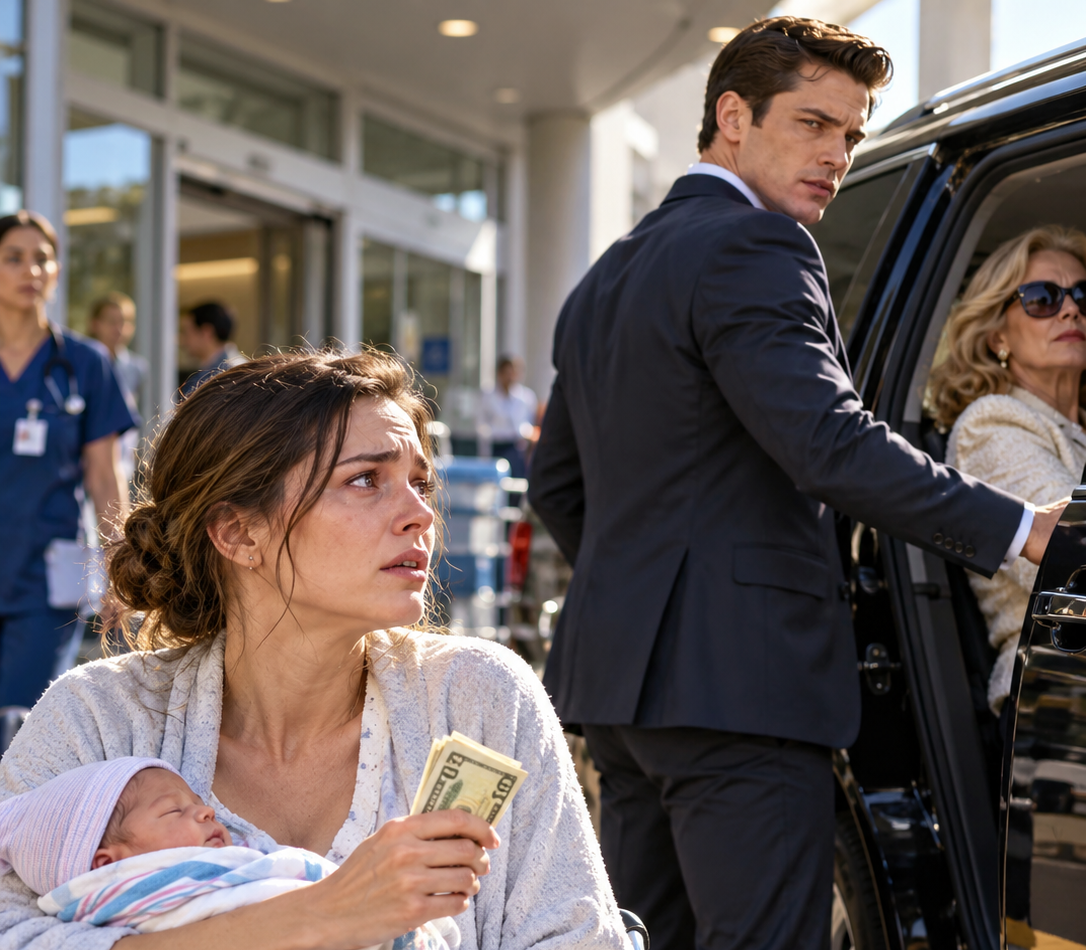
We passed the bus stop where, a year earlier, I had climbed aboard holding a five-day-old baby and twelve dollars.
I stopped.
The shelter looked ordinary.
That surprised me most.
No monument marked the place where my marriage ended. No sign announced that a woman had once stood there making excuses until strangers were kinder to her than her husband.
A bus pulled up.
People got off. People got on.
Then it left.
I reached into the diaper bag and found my wallet. For months, I had kept twelve dollars tucked behind my license without admitting why.
Two fives. Two ones.
I took them out.
A woman near the stop was searching her pockets while trying to calm a crying toddler.
“Excuse me,” she said to the driver. “I’m short.”
I walked over and handed her the bills.
Her eyes widened. “I can’t take all this.”
“Yes, you can.”
She thanked me and climbed aboard.
I watched the doors close.
Then I pushed Noah’s stroller toward home.
The twelve dollars had once been the price Ethan put on getting me out of his way.
They were not worth carrying anymore.