

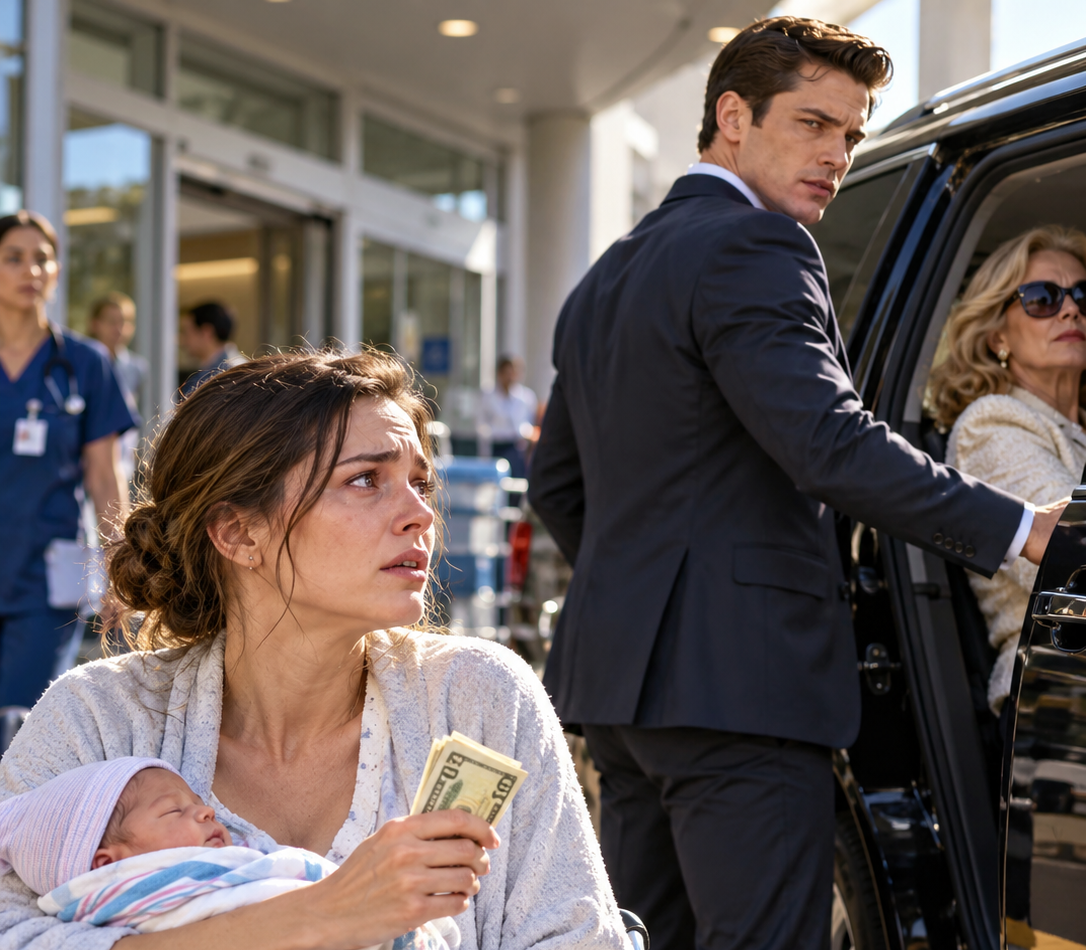
Five days after my C-section, my husband pressed twelve dollars into my hand and told me to take a city bus home with our newborn.
For a second, I thought the pain medication had made me misunderstand him. I was standing under the awning outside St. Vincent’s Hospital in Manhattan, Noah asleep against my chest, my incision pulling every time I shifted my weight. Ethan stood in front of me with my car keys looped around one finger.
“Please tell me you’re joking,” I said.
He glanced at his watch. “The bus fare costs less than that, Claire. You’ll have money left over.”
Behind him, his mother, Diane, made a show of checking the time on her phone. “Ethan, our reservation is in twenty minutes.”
My black SUV waited at the curb. I had bought it two years before we married, mostly because my father had insisted I needed something safe in winter. Ethan had complained about the price until he discovered how much he liked driving it.
“You said you were taking us home,” I reminded him.
“I said I’d pick you up. I did.” He nodded toward his mother. “Mom’s been waiting all week for this lunch.”
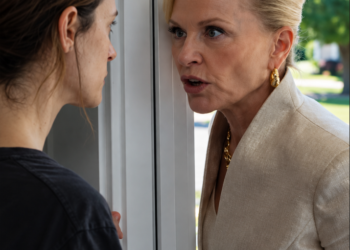
Diane smiled without warmth. “You’ll survive a bus ride. Women used to give birth without all this fuss.”
I looked down at Noah. He was five days old.
“Where’s the diaper bag?”
Ethan opened the rear door, pulled it out, and dropped it beside my feet. When I instinctively bent toward it, white-hot pain tore across my abdomen. I caught my breath and grabbed the side of a wheelchair someone had left near the entrance.
A nurse coming through the automatic doors hurried toward me. “Don’t bend, ma’am. You’re still recovering from major surgery.”
Ethan exhaled loudly. “Can everyone stop making this so dramatic?”
The nurse stared at him.
That should have embarrassed him. It didn’t.
Instead, he opened the passenger door for Diane. During nine months of pregnancy, he had never once done that for me.
His father climbed into the back with Ethan’s sister. Diane settled into my seat, adjusted the mirror, and complained that the hospital valet had moved it too far forward.
Then Ethan got behind the wheel.
“Ethan.”
He looked at me through the open window.
I wanted to ask one more time. I wanted to give him one more chance to see what he was doing.
But something in his face stopped me. He wasn’t confused. He wasn’t overwhelmed. He had made a calculation, and in that calculation, my pain, our son, and my dignity were worth less than keeping his mother’s lunch reservation.
He drove away.
The nurse carried my bag to the bus stop. She offered to call someone, but shame made me say I had it handled. I didn’t. Not yet.
When the bus arrived, the driver lowered the steps without being asked. An elderly woman stood immediately and offered me her seat.
“Sit, sweetheart,” she said. “You shouldn’t be standing with that baby.”
A stranger held the diaper bag while I lowered myself carefully. Another woman asked whether I needed water.
Their kindness hurt more than Ethan’s cruelty because it stripped away the last excuse I had been making for him.
As the bus moved uptown, Manhattan slid past the window in gray September light. I thought about the previous year: Ethan criticizing my spending while using my cards, Diane referring to my apartment as “our family’s place,” Ethan insisting that his name should eventually go on everything because married people did not “keep score.”
I had called his temper stress. I had called his entitlement insecurity. I had called Diane difficult because admitting she was cruel would have forced me to admit that Ethan allowed it.
Noah stirred against my chest.
I looked at his tiny face and understood that the excuses I made now would become the world he grew up believing was normal.
Ethan knew my family was comfortable. He knew my father had retired from government service. He had met Dad twice and dismissed him afterward as “one of those old military guys who still thinks rank matters.”
What Ethan had never bothered to learn was that General Thomas Morgan had retired as a four-star Army commander, had advised presidents and cabinet officials, and still had a phone that people answered on the first ring.
More important, he was my father.
Years earlier, when I complained that Dad never corrected people who underestimated him, he had told me, “Let people reveal who they are before they discover who stands behind you.”
I took out my phone and called his private number.
He answered immediately. “Claire?”
“Dad, I need help.”
His voice changed. “Are you and the baby safe?”
“Yes.”
“Tell me where you are.”
I told him everything. He interrupted only once, to ask whether I needed medical attention. When I finished, there was a long silence.
Then he asked, “Do you want to go back?”
I looked at Noah sleeping against me.
“No,” I said. “I want to leave him.”
Dad’s answer was quiet.
“Then you’ve already left.”
He told me to get off at the next major stop.
Two black sedans were waiting when the bus pulled in. A woman in a dark suit introduced herself as Mara, one of Dad’s longtime security coordinators. The rear seat of the first sedan already held an infant carrier, blankets, bottled water, and the medication schedule I had texted Dad from the hospital.
I had barely settled Noah when my phone buzzed.
Ethan: Mom needs the SUV tomorrow. Don’t make plans.
I stared at the message until I almost laughed.
Then I typed: Check the parking lot first.
Across town, someone was already waiting beside my SUV.
And in his hands were ownership documents Ethan had never once bothered to read.