


Claire read Nina’s message three times before calling her.
The phone rang once.
“I didn’t know whether I should send it,” Nina said.
“My supervisor said you’d signed off and told us not to ask questions.”
“Who is your supervisor now?”
“Daniel.
He moved the finance approvals to his office last month.”
“Did you see me sign anything?”
“No.
The document came through our shared inbox as a PDF.
The signature block was already filled in.”
Claire looked at the bottom of the page again.
Her name appeared in a neat script font she had never used for a signature.
She could not yet prove who had placed it there.
She knew only that she had not authorized the transfer.
“Don’t confront anyone,” Claire said.
“And please keep the original email with its attachments.”
“I already saved it.
I was afraid someone would delete it.”
After they hung up, Claire sent herself copies of the documents she already possessed and wrote down the date and time of Nina’s call.
She did not try to enter Daniel’s office or guess his passwords.
For the first time in years, she wanted a record of what she knew, not another argument about what he claimed she had forgotten.
Sunday morning, she called Marisol Vega, an attorney whose small business practice had helped one of their early subcontractors.
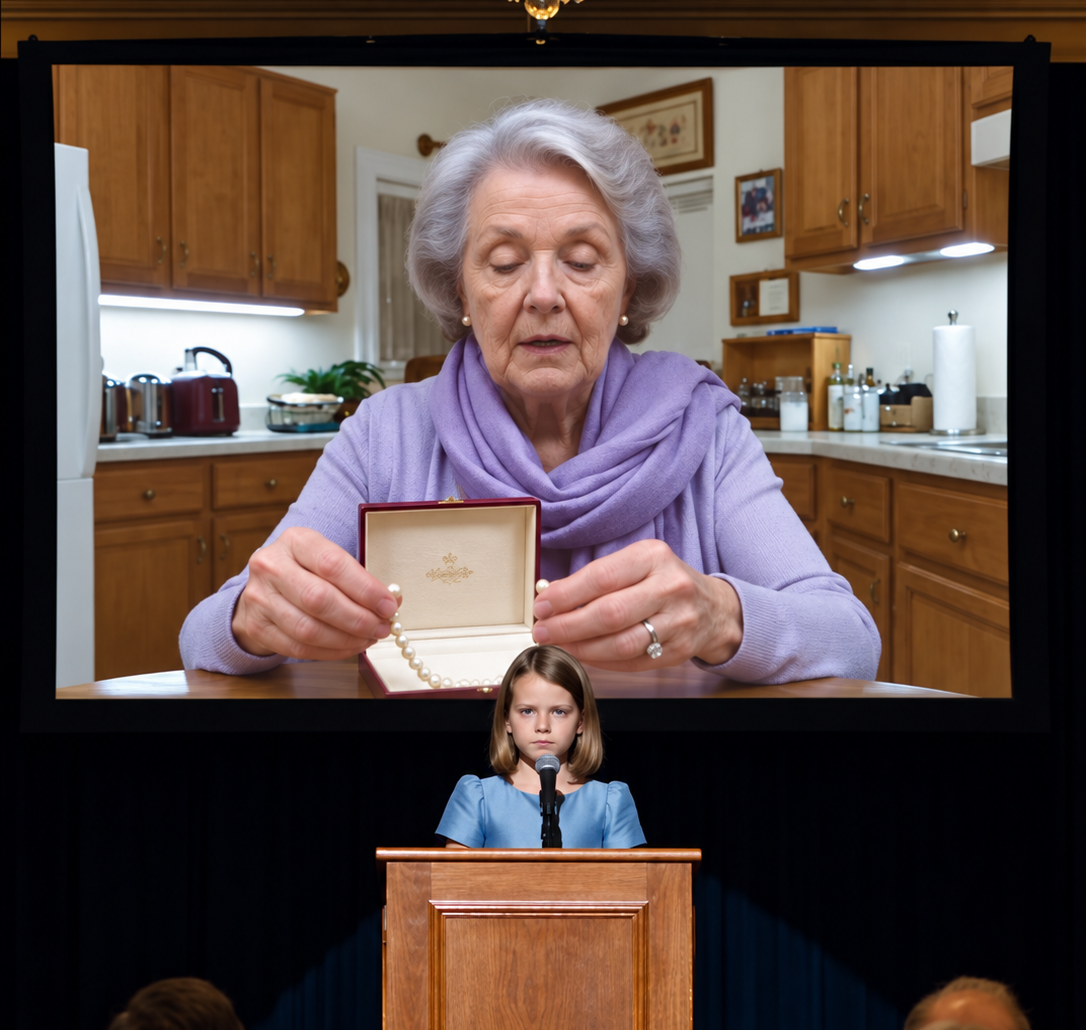
Marisol listened without interrupting as Claire explained the dinner, the pearls, and the electronic signature.
“Bring the original company documents you have,” Marisol said.
“Don’t sign anything.
And don’t assume the PDF tells us the whole story.”
Claire left Ellie with a trusted neighbor for the appointment.
Before she left, she found her daughter sitting at the kitchen table, carefully winding the ribbon of her blue dress around one finger.
“People have videos,” Ellie said.
“One girl from school sent me a clip.”
Claire’s heart sank.
“Did someone threaten you?”
“No.
She said I was brave.
But I didn’t want everyone to know.”
“I asked them not to post you,” Claire said.
“I wish that had been enough.”
Ellie stared at the dress.
“I thought if everybody saw it, Dad couldn’t pretend anymore.”
“He may still pretend,” Claire answered.
“But you don’t have to prove anything else.
I’ll handle the adult part now.”
Marisol’s office occupied two rooms above a pharmacy.
There were no impressive portraits on the walls, just shelves of binders and a kettle near the window.
Claire found that reassuring.
They spread out the old paperwork.
There was the original operating agreement for Harrison Custom Homes, LLC, signed when Claire and Daniel were still renting their first house.
Its ownership schedule listed them as equal members.
They had each put in what little money they could, and later contributed labor and resources that never showed up neatly in a single column.
“Has anyone bought out your interest?” Marisol asked.
“No.”
“Have you signed an amended ownership agreement?”
“Not that I remember.”
“Then we verify the current records before making claims.
But this is a meaningful place to start.”
Marisol circled a provision requiring both members to approve a sale or transfer of substantially all operating assets.
The document did not mean Claire could simply walk into the office and remove Daniel.
It did mean her consent mattered for decisions he had apparently been making without her.
Next they read the proposed transfer.
Harrison Development Partners had been registered less than two weeks earlier.
Daniel was named as its sole manager.
The schedule included several active building contracts, company vehicles, and the equipment the crews used every day.
The stated purchase price was suspiciously low compared with the company’s last financial statement.
“Why would he move everything?” Claire asked.
“I can’t tell you his intent from this alone,” Marisol said.
“But an asset transfer to another company he controls could leave the original business with obligations and much less to operate with.
We need the full transaction records.”
Claire thought of the men who had waited for paychecks twenty years earlier.
She could still picture their faces when she handed each one an envelope.
Some of their sons now worked at Harrison Custom Homes.
“Can we stop it?”
“We can send notice that you dispute the consent and request that records be preserved.
If there’s an imminent transfer, we may need emergency court relief.
First, we establish what has and hasn’t happened.”
Claire authorized Marisol to act.
For once, there was no reason to ask Daniel whether he thought a decision was sensible.
On Monday, Nina confirmed that the transfer had been scheduled but not completed.
The lender had been asked to review it, and a closing date had been proposed for the end of the week.
Marisol sent formal notices to the company, its transaction counsel, and the relevant lender.
She asked that no one rely on Claire’s purported signature until its authenticity could be examined.
Then Claire called Hannah.
Her older daughter answered from a campus courtyard, carrying a coffee cup and looking as tired as Claire remembered being at twenty.
“Ellie called me,” Hannah said.
“Not about the business.
She asked whether you were okay.”
“I don’t know yet.”
“Do you want me to come home?”
“I want you to finish your exam.
Then come when you can, because I’d like both my girls at the table.”
Hannah nodded.
“Mom, I remember that old office.
I remember doing homework under your desk.
I never thought Dad built it by himself.”
When the call ended, Claire sat still for several minutes.
She had spent years measuring her usefulness by what Daniel acknowledged.
Hannah’s simple memory reminded her that some things had never disappeared, even when he stopped naming them.
That afternoon, Daniel’s attorney responded to Marisol.
He denied any forgery and insisted Claire had authorized the transaction verbally.
He offered to meet, but only if Claire first agreed not to contact employees or customers.
Marisol refused that condition while advising Claire to keep communications factual and narrow.
Just before closing time, Nina sent another message.
The company’s payroll account was adequately funded, but Daniel had changed the approval settings.
The next payroll batch now required a final release from his login.
He had not released it.
Claire looked at the names on the payroll report.
Forty-three people.
Forty-three households depending on work they had already done.
Then Daniel called.
“Withdraw the complaint about the transfer,” he said, “and I’ll make sure everybody gets paid.”
Claire heard no apology in his voice.
She heard the same bargain he had made for years, only this time other families were standing on the other side of it.
To see how Claire responds when Daniel puts forty-three paychecks on the line, continue with Part 4.