

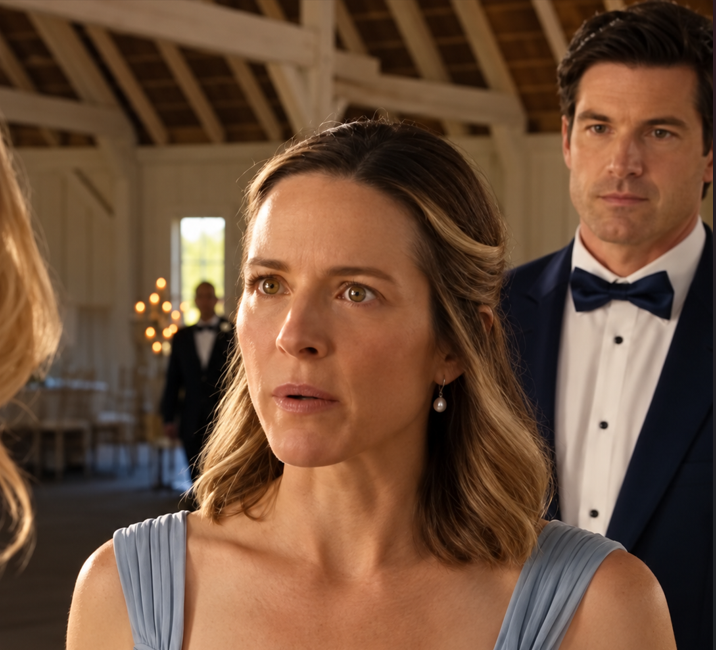
For a moment, the reception area went quiet.
A few guests had been looking toward the cake table.
Others were holding drinks, trying not to stare at the argument unfolding near the barn doors.
I could feel the familiar pressure to smooth things over before anyone became uncomfortable.
Daniel looked at me instead of unlocking his phone.
“Claire?”
That small pause changed everything.
He wasn’t asking my mother or my sister how the day should proceed.
He was asking me.
“Show them what was sent,” I said. “But not to put our marriage on trial. I want the lies to stop.”
Daniel opened Natalie’s original messages and held the screen where Elaine, Susan, my father, and several nearby guests could read them.
He showed the timestamp from Friday night, the attachment accusing me of an affair with Evan, and Natalie’s warning not to tell me who had sent it.
“This came from Natalie,” he said. “She said Claire had written these messages. I asked Claire about them this afternoon, and I apologized for making her feel as though she had to guess what I was accusing her of.”
Natalie attempted a smile.
“I was protecting you. You should be thanking me.”
“From what?” Daniel asked.
Evan came up beside us.
He told the group that he and Natalie had separated three weeks earlier and that the number shown in the screenshot had been disconnected in February.
He offered the company notice to anyone who needed confirmation.
“Those conversations never happened,” he said. “I didn’t ask my wife to send anything to Daniel. I didn’t even know she was telling people I was in Denver.”
Natalie’s face reddened.
“Oh, so everybody believes him now? That’s convenient.”
“We believe the dates,” Daniel said. “We believe that the number didn’t exist on Thursday. And we know who forwarded the picture.”
Susan looked at Natalie, then at the repaired blue bodice beneath my ivory wrap.
“Did you also take Claire’s wedding dress?”
My mother spoke before Natalie could answer.
“I helped move it,” she admitted. “I thought the wedding needed to be delayed until everyone could talk.”
“You didn’t ask me for a conversation,” I said. “You took away my clothes.”
A woman from Daniel’s side of the family quietly set her glass on a table.
No one laughed.
No one called me emotional.
Natalie turned toward my father.
“Are you seriously going to stand there and let them humiliate me?”
Frank looked almost ill.
“I stood there thirteen years ago,” he said. “I’m not doing it again.”
Natalie stared at him.
“You always take her side when she cries.”
I nearly laughed at how completely she had reversed our childhood.
“I’m not crying right now,” I said. “And you still haven’t answered the question. Why did you keep my prom dress?”
For a long moment, she looked at everyone except me.
“Because you always get to act like the good one,” she said finally. “You go off and build this perfect little life, and everyone acts as if I’m supposed to clap for you.”
“I never asked you to clap.”
“Mom spent months talking about this wedding while my marriage was falling apart. And you didn’t even notice.”
“You told me Evan was busy with work,” I reminded her. “Every time I asked if you were okay, you said you were fine.”
Her expression shifted.
For an instant she looked tired rather than furious.
Then she pointed at the blue dress.
“I knew you’d turn it into another story about yourself.”
“It’s my wedding,” I said. “It was my dress. I don’t need your permission to be hurt by what you did.”
Daniel asked Jenna to escort Natalie from the reception.
I agreed.
My mother began to protest, then stopped when I looked at her.
She followed Natalie outside without saying goodbye.
The silence they left behind wasn’t comfortable, but it was real.
Susan apologized for listening to rumors without asking questions.
Elaine touched my shoulder and admitted she should have challenged Mom’s description of me at the rehearsal dinner instead of simply nodding.
I thanked them, though I wasn’t ready to pretend none of it had happened.
Frank asked whether I wanted him to leave too.
“No,” I said. “But I need you to speak up when it matters, not just afterward.”
He nodded.
This time he didn’t promise more than he could prove.
The DJ started the music again.
People gradually returned to their tables, and dinner came out only a little later than planned.
Rachel helped me change into my original ivory gown before our first dance.
Its lace hadn’t been cut, its zipper still worked, and the dress was every bit as beautiful as I’d remembered.
I wore it because I wanted to, not because anyone had convinced me the blue dress was shameful.
Daniel waited by the dance floor.
“Two wedding dresses,” he said as I approached. “I think you might have made history.”
“Don’t start explaining a historical technicality,” I warned.
He smiled.
Then, more seriously, he said, “Next time somebody tells me something about you, I come straight to you. No riddles.”
“And I promise not to pretend everything is fine when it isn’t.”
We danced badly.
Several people cheered anyway.
For the first time all day, I didn’t mind being watched.
In the weeks afterward, things didn’t become simple.
Natalie sent a message saying I’d embarrassed her in front of the whole family.
I replied once: she had taken my dress, made up a conversation, and told people I was unfaithful. I would not discuss reconciliation until she could acknowledge those choices without calling them jokes.
She didn’t reply.
Mom left a voicemail saying the matter could have been handled privately.
I didn’t call back.
Later, I wrote to tell her I would meet her when she was ready to discuss what she had actually done, not whether other people had seen it.
Dad called separately.
He asked if he could take Daniel and me to lunch.
I agreed, with the understanding that we would talk honestly and that Natalie would not be invited as a surprise.
We kept the original wedding pictures, including the ones of me entering the barn in pale blue.
In one photograph, the repaired seam is plainly visible.
I used to think a mark like that meant the whole day had been ruined.
Now I look at Daniel’s face in that picture and remember that he was waiting for me, not for a perfect dress.
I still work as an emergency dispatcher.
I still listen for pauses and changes in people’s voices.
But when someone in my family says I’m being difficult simply because I’ve asked a direct question, I no longer accept the label as an answer.
On my wedding day, I wore the dress my sister intended as a warning.
It became something else when I chose to walk through those doors.
Not proof that her cruelty didn’t hurt, because it did.
Proof that hurting me no longer gave her the right to decide what happened next.
[ THE END.]
The pale blue dress was supposed to make me feel eighteen again, standing in a bathroom while everyone else went to prom. I remember the rough edge of the ticket pinned to its shoulder more clearly than I remember the music at my wedding. That frightened me at first. It meant an old humiliation could still reach me after thirteen years. I’d learned to catch fear in a stranger’s cheerful voice, yet I could barely recognize the fear in my own whenever my mother said I was overreacting. What stayed with me wasn’t the stain. It was how close I came to going quiet again.