

Allison answered the email question in a conference room three weeks later.
By then, Northline was cooperating with the accounting, and Allison had produced invoices, contracts, and bank records. She was not under oath, but everyone understood her words could matter later.
Mara sat beside me. My father and mother had separate counsel.
That said enough about what our family had become.
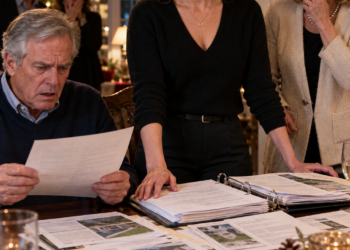
Ben placed the email chain on the screen.
Rachel will never agree if we make this formal. I’ll handle her page.
Just get it done. We can explain later.
Allison stared at her own reply.
Her lawyer said, “Tell them what you understood at the time.”
She rubbed her thumb along the edge of her notebook.
“I knew Rachel hadn’t agreed to the financing.”
My father shifted in his chair.
“Allison.”
Her lawyer held up a hand. “Let her answer.”
Allison swallowed.
“I thought Dad was going to close it and then get Rachel to approve the paperwork afterward.”
“Why would she approve it afterward if she wouldn’t approve it beforehand?” Mara asked.
Allison looked at me.
“Because once it was done, I thought she wouldn’t blow everything up.”
There it was.
Not confusion.
Not a forged signature she knew nothing about.
A calculation based on who I had always been.
The daughter who complained but stayed.
The sister who got angry but eventually came to Thanksgiving.
The person who could be pressured with consequences created by other people.
“Did you know your mother would sign Rachel’s name?” Mara asked.
“No.”
“Did you know Rachel’s license would be used?”
“No.”
I believed her.
It did not erase what she had known.
My father leaned toward his attorney and whispered something. The attorney’s face tightened.
When the meeting broke for lunch, my mother asked if she could speak to me in the hallway.
Mara glanced at me. I nodded.
My mother looked exhausted. She had stopped coloring her gray roots since Christmas, which was such a small thing that I felt ashamed for noticing it.
“The county attorney offered us a diversion agreement on the child case,” she said.
“Our lawyers think we should take it.”
The proposed agreement required my parents to accept responsibility, complete parenting and safety education, comply with a no-unsupervised-contact condition involving Ava, and avoid any new violations during the program period. If they completed it, the charge would be resolved without a trial.
It was not a dramatic punishment, but it was not nothing.
“What are you going to do?” I asked.
“I’m taking it.”
“And Dad?”
Her mouth tightened. “He says accepting it makes him look guilty.”
“You left a six-year-old alone.”
“I know.”
The words came without an excuse.
I waited.
My mother looked at the floor.
“I wrote the note.”
“I know that too.”
“I wanted to hurt you.”
That was harder to hear than any denial.
She continued before I could respond.
“Your father was furious that you wouldn’t lend Allison money directly. I was angry that you kept questioning the trust. We told ourselves you expected us to raise Ava while you worked. The trip felt like taking something back.”
I felt sick.
“Ava was six.”
“I know.”
“You used her to punish me.”
“Yes.”
My mother began to cry, but she did not reach for me.
For once, she let the fact exist without making her tears the center of it.
“I don’t expect you to forgive me,” she said. “I wanted you to know I stopped telling the investigator that I thought you were coming early. I told her the truth.”
“What truth?”
“That I knew your shift ended that evening.”
My chest tightened.
“Why now?”
“Because every lie I told to protect this family protected the worst thing we did.”
She walked away before I had to answer.
That afternoon, my father proposed a settlement.
He would resign as trustee, repay certain disputed management fees, and support restructuring the bank debt. Allison would return a portion of payments that the independent fiduciary classified as unsupported or excessive. In exchange, he wanted the beneficiaries to release civil claims connected to past trust administration.
The proposal was not absurd. Mara said parts of it could become the basis of a fair settlement.
Then we reached paragraph eleven.
I would agree that the disputed guaranty resulted from a “family misunderstanding regarding authorization” and would request that the lender and any investigating agencies treat the matter as resolved.
I looked up.
“No.”
My father stared back at me from across the table.
His attorney said, “Rachel, the language does not require you to say you signed it.”
“It requires me to call it a misunderstanding.”
Mara closed the draft.
“We won’t agree to that provision.”
My father finally spoke directly to me.
“You want to destroy me.”
I felt the old reflex rise: explain, soften, reassure.
I let it pass.
“I want the record to say I did not authorize my signature.”
“You have made your point.”
“This was never a point.”
“Then what do you want?”
The question sounded genuine, making it sadder.
“I want my name to belong to me. I want the trust managed transparently. I want Ava safe. I want you to stop asking other people to absorb the consequences of your decisions.”
He leaned back.
“Families survive because people absorb things for each other.”
“Sometimes. With consent.”
His face hardened again.
Mara asked for a break.
In the hallway, Allison came after me.
“Rachel.”
I turned.
She looked toward the conference-room door.
“I’ll support removing paragraph eleven.”
I said nothing.
“And I’ll sign a declaration about the email. What I knew. What I didn’t.”
“Why?”
She took a long breath.
“Because Dad asked me this morning to say I thought you had already approved the loan.”
I felt no surprise. That was the strangest part.
“What did you tell him?”
“No.”
For the first time in my life, my sister had disappointed our father on purpose.
It did not repair us.
But it mattered.
Two weeks later, the settlement moved forward without paragraph eleven. My father resigned as trustee. The independent fiduciary became permanent. Repayment amounts would come from my father’s management company and from Northline according to the accountant’s findings, not from the trust itself.
The bank negotiated a new loan structure based on the property’s actual value and the guarantees of those who agreed to provide them.
My name was not one of them.
The financial-crimes review remained open. Mara warned me not to predict what prosecutors would do. The civil settlement could repair money; it could not erase how the signature had been obtained.
On the evening we signed the trust settlement, my father waited until everyone else had left.
“Rachel,” he said.
I stopped at the door.
He looked older than I remembered him looking at Christmas.
“I did all of this because I was trying to keep the family secure.”
I held his gaze.
“No. You did it because you decided security was something you were allowed to choose for everyone else.”
He did not answer.
This time, neither did I.
I walked out before he could turn my silence into permission.