


A year after the Christmas that split our family open, I was sitting in a conference room signing closing documents for a small brick townhouse on the edge of town.
It had two bedrooms, one and a half bathrooms, an absurdly narrow kitchen, and a maple tree in the back that dropped leaves faster than I could rake them. There was no breakfast island. The upstairs hallway creaked. The previous owner had painted one bathroom a shade of green that looked radioactive in daylight.
I loved every imperfect square foot.
The down payment came from my savings. Not from my parents. Not from a secret family arrangement. Not from money borrowed against somebody else’s home. Mine.
Nina came to the closing because she had spent the previous year listening to me compare interest rates as though they were celebrity gossip. Lauren arrived afterward with coffee and a toolbox.
“I brought you a housewarming present,” she said.
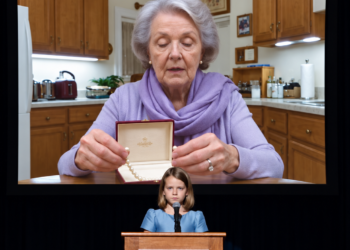
“If there’s a key in a velvet box, I’m throwing you out.”
She laughed. “Screwdrivers.”
“Acceptable.”
My parents came that evening.
I had debated inviting them. A year earlier, I might have invited them automatically and then resented their presence. This time I asked myself what I actually wanted.
I wanted them there.
Mom carried a casserole. Dad carried a set of shelves he had built in his garage from leftover oak. He had measured the wall after I casually mentioned needing storage, then asked before making them.
That last part mattered.
“Where do you want these?” he asked.
“Office.”
He nodded. “Your house.”
It was a simple sentence, but I heard the difference.
My parents were still in the condo. Dad’s business was smaller and, according to him, boringly predictable. He had one employee and a bookkeeper who sent monthly reports directly to both him and Mom. Mom worked four days a week and liked having her own paycheck more than she expected.
Dad had repaid $1,275 of the $38,416. At that pace, the full amount was not the point. The transfers arrived only in months when he had genuine surplus. Sometimes they were $50. Sometimes $150. Twice there was nothing. I never asked.
More important, nobody treated me as the household contingency fund anymore.
Lauren’s townhouse remained rented. She had decided she might move into it eventually, but she no longer talked about it as the magical beginning our parents had promised. It was property: useful, expensive, occasionally irritating property with a water heater that had already needed servicing.
“Adulthood is mostly calling people about appliances,” she told me.
“I could have told you that.”
“You did. I wasn’t listening.”
Christmas that year was held at my parents’ condo because Mom insisted her kitchen was bigger than mine by six inches and intended to use every one of them. There were fewer decorations. Dad had sold the enormous artificial tree and bought a smaller one that fit beside the balcony door.
After dinner, we exchanged gifts.
Mom gave Lauren a set of good kitchen knives. Dad gave me a cordless drill.
“No lecture?” I asked.
“Instruction manual’s in the box.”
“I meant about homeownership.”
He looked embarrassed. “I figured you know what things cost.”
Lauren nearly choked on her wine.
Later, while Mom and Lauren washed dishes, Dad and I stood on the balcony. The air was cold enough to sting.
“I hated that condo when we first moved in,” he said.
“I know.”
“Felt like everybody could see I’d gone backward.”
“Can they?”
He looked through the glass door at Mom laughing with Lauren.
“Maybe. I just don’t care as much.”
That might have been the biggest change of all.
He asked whether I was happy in my townhouse.
“Yes.”
“Scared?”
“Also yes.”
“Good.”
I raised an eyebrow.
“Not good that you’re scared,” he corrected. “Good that you bought something you can afford and you’re still scared. Means I wasn’t going to find some magical number where fear disappeared.”
I smiled. “No magical number.”
When I left, Mom tried to send me home with enough leftovers for a week. Lauren stole half of them. Dad carried my bag to the car.
Before I got in, he said, “Claire.”
I turned.
“Thank you for leaving.”
I stared at him.
He shoved his hands into his coat pockets. “I hated you for it. But if you had paid that next mortgage payment, I would’ve asked for another. Then another. I know that now.”
There were a hundred things I could have said. That I had not left to teach him a lesson. That I had spent months wondering whether I had been cruel. That boundaries are easier to praise after they work than while everyone is furious about them.
Instead I said, “I’m glad you figured it out.”
“Me too.”
At home, I unlocked my front door and stepped into the quiet townhouse. The shelves Dad built were mounted in my office. Lauren’s toolbox was still under the kitchen sink. A container of Mom’s casserole sat in my refrigerator despite Lauren’s theft.
Family was still everywhere.
It just was not attached to my checking account anymore.
I went upstairs and opened the desk drawer where I kept Dad’s old spreadsheet. The total at the bottom still read $38,416. I no longer looked at it often. It was not a score, and it was not a debt I planned to use against him.
It was evidence of a version of me who had believed love became more legitimate the more it cost.
I had not stopped loving my family when I stopped paying.
I had stopped making payment the price of belonging.
I had once imagined that buying my own place would feel like proving something to my parents. By closing day, that urge was gone. The house did not prove that I had won and they had lost. It proved that my future could be planned around my income, my choices, and my limits rather than around the next emergency someone else created.
Before bed, I placed my own brass house key on the small dish beside the door. No velvet box. No audience. No camera recording the moment.
Just a key I had earned, to a house I could afford, waiting exactly where I had chosen to put it.