

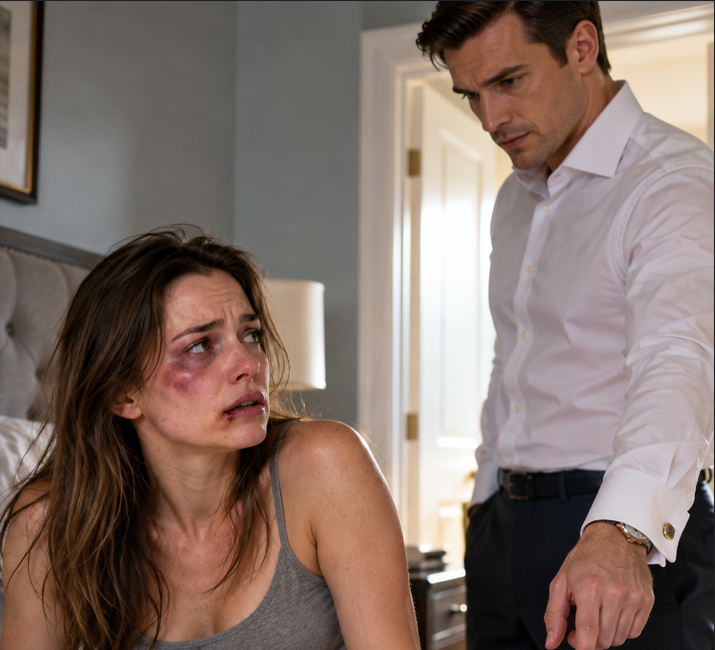
My father did not ask what I had done to deserve the bruises.
He did not ask why I had waited so long to call.
He asked whether Julian was home and whether I could leave safely.
“He left for work,” I said.
“He’s coming back at noon.”
“Then we have some time.
Are you having trouble breathing?”
“A little.
My ribs hurt.”
“Call emergency services if it gets worse.
I’m coming, and we’re getting you examined.”
I almost told him not to make a scene.
That was the sentence I’d been trained to say whenever another person’s behavior had consequences for me.
I swallowed it.
“Dad, there’s something else.
Julian and Eleanor have been using my name on loan documents.”
He was quiet for two beats.
“Don’t confront them,” he said.
“Save what you have, and don’t send anything from your work account.
We’ll find someone who handles this properly.”
My father, David Bennett, had spent twenty-six years investigating financial crimes for the state before retiring.
He believed documents mattered, but he had never confused a file with the person it was supposed to protect.
That distinction was one I had forgotten.
While I waited, I packed one suitcase with medication, identification, a change of clothes and the old photograph of my mother I’d kept in a drawer.
She had died when I was twenty-three.
I packed the deed to my townhouse, then took it out again because my attorney could get a certified copy and I was afraid Julian would see me carrying it.
In the end, I photographed it and left the paper where it had always been.
I called the local police department and explained what had happened.
The dispatcher sent an officer to speak with me.
I also called a domestic violence hotline, where an advocate helped me consider how to leave without placing myself back in Julian’s reach.
She did not tell me I had to make every decision that morning.
She asked where I could be safe for the next twenty-four hours.
It was such a small question.
I could answer it.
When my father arrived, he stood inside the doorway as if he were afraid one sudden movement would frighten me.
His hair had gone almost entirely gray.
He wore the same dark green jacket I remembered from the last time we’d argued.
He looked at my face.
I saw him understand.
“I’m here,” he said.
That was all.
I sat down on the stairs and cried with the ugly, breathless kind of crying I’d hidden from Julian for years.
Dad sat beside me without touching my injured side.
The responding officer took my account, and I provided the names of the people involved and the records I had preserved.
I described the slap, the impact against the dresser and the kicking.
I gave the officer the security file’s location without pretending I knew whether every recording would be admissible.
When the officer asked if I wanted to report the assault, I heard Julian’s voice in my head telling me I would ruin his life.
“Yes,” I said.
“I do.”
At a medical clinic, the doctor examined my injuries and arranged imaging because of the pain under my ribs.
I had a cracked rib and extensive bruising.
The doctor explained what symptoms required urgent care and documented the injuries in my chart.
The advocate helped me understand my options for a protective order and how to ask about temporary use of the home.
By then it was nearly eleven.
I wanted to call my office and invent a stomach virus.
Instead, I told my manager I had a medical and personal emergency, that I would be unavailable for the day, and that I would follow the proper procedure for leave.
I did not mention my files or ask anyone at work to help investigate my marriage.
Dad had already contacted an attorney he trusted, Hannah Sloane, who practiced family law and had experience coordinating with lawyers handling identity theft.
She spoke to me by phone while I sat with a heating pad against my side.
“First, you need somewhere safe,” Hannah said.
“Second, notify the lenders of the suspected fraud.
Third, keep copies of everything, but do not go into a shared account to change or erase things that might become evidence.
We’ll deal with the house through the right legal process.”
“I don’t want Julian to know where I am.”
“Then don’t tell him.
We can communicate through counsel.”
I had one more request.
I wanted Dad to be at the townhouse when Julian returned with Eleanor.
I didn’t want Dad to threaten him or announce a punishment.
I wanted the last thing Julian expected to find in that room to be a witness who knew I had left voluntarily.
Dad looked uncomfortable.
“I won’t stay if he becomes violent,” he said.
“And I won’t tell him where you’ve gone.”
Hannah advised him not to argue over property or block Julian from entering a home where he currently lived.
He agreed to keep the meeting brief, with his phone ready to call for help and Hannah available.
I asked him to leave the minute he felt unsafe.
There was a reason I wanted him there.
For five years Julian had portrayed my father as a controlling man who would take over my life if I gave him half a chance.
I needed to prove, perhaps more to myself than to Julian, that I could ask for help without surrendering my decisions.
Before Dad went back, I stopped him at the clinic entrance.
“Why didn’t you call?” I asked.
“After everything that happened five years ago?”
He stared at me.
“I did,” he said.
“Twice in the first month.
Then I wrote to you.”
“I never got letters.”
His expression changed in a way I couldn’t yet read.
“You told me to stop,” he said.
“In an email.
You said you didn’t want me at your wedding, your home or anywhere near your husband.”
“I didn’t write that.”
We stood under the clinic awning while people walked past with paper appointment slips in their hands.
Dad took a slow breath.
“We’re not going to settle five years in a parking lot,” he said.
“But I kept the correspondence.”
Then he left for the townhouse.
I stayed at a location Julian didn’t know, with the advocate’s safety guidance in front of me and my second phone on the table.
My suitcase was beside the chair.
For the first time in years, I had nowhere I was required to be at noon.
The living-room camera was still accessible from my phone.
I had preserved the existing footage and made no changes to the system.
I told Dad I could see the front door and that he should not count on the camera to protect him.
At 12:07 p.m., Julian came in carrying a white bakery box.
Eleanor followed, wearing a cream-colored coat and the pearl necklace she wore whenever she wanted to look respectable.
“Why is her car here?” Eleanor asked.
“Because she lives here,” Julian said.
“Don’t start.”
He set the box on the kitchen counter and saw the untouched makeup bag through the bedroom doorway.
His shoulders tightened.
Then he entered the living room.
Dad was sitting in the armchair by the window, with his hands resting on his knees.
He did not stand up.
“Hello, Julian.”
The bakery box hit the counter behind Julian with a sound that made me flinch, even through the phone speaker.
“What are you doing here?” Julian demanded.
“Audrey invited me.
She’s safe.
She’s receiving medical care.”
Julian’s eyes went from Dad to the hallway and back.
“Where is she?”
“I’m not telling you.”
“She’s my wife.”
“She’s an adult,” Dad said.
“And she’s asked you to communicate through her attorney.”
Eleanor stepped into view.
For a moment she looked puzzled, then irritated.
“David,” she said.
“I thought we had agreed you would respect their marriage.”
“I respected Audrey’s request for distance,” Dad answered.
“Today she asked me to come.”
Julian made a short, sharp movement toward the coffee table.
“Whatever she’s told you, it isn’t what happened.”
“I haven’t come to debate her injuries.”
“You don’t know anything about our relationship.”
“Then let the authorities establish the facts.”
Eleanor folded her hands.
She had used that pose at holiday dinners when delivering an insult she expected everyone else to swallow.
“Audrey gets overwhelmed,” she said.
“She misunderstands people when she’s under stress.”
Dad looked at her.
“She told you no about selling her house,” he said.
“Was that a misunderstanding?”
Eleanor’s fingers tightened over each other.
“We were trying to make a practical arrangement.”
“Then there is no reason for anyone to pressure her into signing documents.”
Julian’s face changed.
He seemed less upset that Dad had seen the bruises than that he had mentioned documents.
“Who said anything about documents?”
Dad stood slowly.
“I’m leaving now.
Audrey has counsel.
The lenders have been notified that certain signatures may not be hers.”
That last sentence had been authorized by Hannah, who had arranged for the initial fraud notices to go out after Audrey’s calls.
It was the only thing Dad said about the finances.
He did not accuse Julian of a specific crime, quote the security recording or mention where I was staying.
Eleanor crossed the room toward the hallway desk.
She pulled open the drawer where Julian kept household paperwork.
“Where’s the folder?” she asked.
Julian didn’t answer.
“The blue folder, Julian.”
Dad moved toward the front door rather than toward Eleanor.
He had promised me he wouldn’t try to take anything from them.
I watched him honor that promise while every part of me wanted someone to seize the drawer and demand explanations.
Julian blocked the doorway with one arm.
“You always wanted her away from me,” he said.
“You’re enjoying this.”
Dad stopped several feet away.
“No,” he said.
“I wanted my daughter to be able to disagree with you and still be safe.”
For a second neither man moved.
Then Julian lowered his arm.
Dad walked out and called me once he was in his car.
“I’m clear of the house,” he said.
“They know you’re gone.
I didn’t give them anything else.”
I let out a breath I hadn’t realized I was holding.
The encounter I’d imagined as a victory felt nothing like one.
Julian still had keys.
Eleanor still knew how to make my refusal sound like an offense.
And I still felt afraid when I heard my husband’s voice raised in a room I wasn’t in.
At 12:31, a fraud analyst at one of the lenders called me back.
She confirmed that my identity-theft report had been received and that further disbursement was being reviewed.
Then she asked whether I had signed a durable power of attorney authorizing Julian to act for me in a property-related loan application.
“No,” I said.
“Absolutely not.”
“There is a notarized document in the application packet,” she said.
“We can provide a copy through our secure process.
The file also identifies a witness.”
I expected Eleanor’s name.
Perhaps a friend of Julian’s.
The analyst read the witness line, and I felt the room become very still.
“David Bennett.”
My father had not spoken to me in five years.
Yet someone had placed his signature beside mine on a document designed to put my home within Julian’s reach.
To understand why my father’s name appeared there, continue with Part 3.