


“It’s a payment to a contractor,” Daniel said.
“Then tell me what the contractor did.”
He lowered his voice.
“Not in front of your mother.”
“She’s already seen the payment. And Tessa is here because I asked her to be.”
Tessa moved to stand beside me, close enough that our shoulders touched.
She didn’t say anything.
That was one of the reasons I’d wanted her in the room.
She knew when the person asking questions needed space to finish them.
Daniel pointed at my phone.
“Hawthorne helped coordinate services. Transportation, rentals, the complicated stuff you didn’t want to deal with.”
“I remember approving a transportation quote from the venue,” I said.
“And I remember the rentals being included in our reception package.”
“Things changed.”
“Then show me where they changed.”
His jaw tightened.
“I don’t have every invoice memorized.”
“Neither do I. That’s why we saved them.”
I opened the shared wedding folder on my phone.
For most of the past year, Daniel had updated a spreadsheet on Sunday evenings while I sat beside him with a notebook.
He called it our little company, and I liked that he made the boring work feel as though we were building something together.
The file had color-coded columns, each one ending in a neat total.
Looking at it now, I could remember dozens of evenings when I asked whether we were staying within our budget and accepted his answer without looking more closely.
There were entries for Hawthorne Event Management in April, August, and October.
The first two totaled fifteen thousand six hundred dollars.
The most recent, Friday’s transfer, brought the amount to twenty-five thousand four hundred.
I had imagined that figure belonged to several vendors.
It was actually one payee.
“This is nearly half of what we put into this account,” I said.
Daniel’s face went pale.
“You’re making it sound worse than it is.”
“Then make it sound accurate.”
I tapped the April entry.
A PDF invoice opened under an unfamiliar black-and-white logo.
It listed event logistics, supplier coordination, and administrative support.
There were no addresses for the supposed suppliers, no itemized hours, and no names of staff assigned to the wedding.
The August invoice was equally vague.
Friday’s described final transportation and event staging.
“Did we book buses?” I asked.
“Not buses. Cars for the families.”
“My mother drove herself here. Your parents drove themselves.”
“There were other arrangements.”
“Which ones?”
He stared at the floor.
Then he said the sentence I would think about for months.
“You said you trusted me to handle it.”
I had said that.
At our dining room table, after another long day at work, I had said I trusted him.
But I had never thought trust meant surrendering the right to ask a question.
Mom cleared her throat.
“Claire, when he and I argued two years ago, he told me Hawthorne was a business he was closing. I remembered because he said he’d lost money on a contract.”
I looked at Daniel.
“You told me it was dissolved.”
“The old operation closed,” he said.
“The company name is still registered. There’s nothing improper about that.”
“Do you own it?”
He didn’t answer at once.
“Do you own Hawthorne Event Management?”
“I’m the managing member.”
I sat down because I wasn’t sure my knees would keep me standing.
Across the desk, Audrey’s email remained open on the tablet she’d left for us to review.
It was a small office, with a printer, a calendar, and a bowl of wrapped peppermints.
I became oddly aware of the peppermints as Daniel stood in front of me and explained that he’d used his business to secure better rates.
“From whom?” I asked.
“You don’t understand how events work.”
“Then explain it to the woman paying for the event.”
He exhaled sharply.
“This isn’t how I pictured our wedding day.”
“It isn’t how I pictured it either.”
Audrey knocked before coming back inside.
She had checked with the catering manager, and they needed to know whether to hold dinner or begin changing the schedule.
I asked whether Hawthorne Event Management had provided any services through the venue.
She said she wasn’t familiar with the company but could confirm what her office had arranged.
“Our package includes the main rentals, the ceremony setup, staff, and your agreed shuttle service from the hotel,” she said.
“Your final invoice shows those items.”
“Are there any outstanding charges for another coordinator?”
“Not from us.”
Daniel laughed once, without humor.
“There. You see? They wouldn’t know.”
“Then we’ll call the person who would,” I said.
I asked Audrey to hold dinner for another fifteen minutes while we decided what to tell the guests.
She explained that staff would still need to be paid even if the ceremony was canceled.
I understood.
There were real people working in that building, and whatever Daniel had done didn’t make their time worthless.
After she left, Tessa opened the public business registry on her phone.
She typed the company name and our state.
The record listed a mailing address I knew.
It was the office building where Daniel rented a small suite for his consulting work.
His name appeared as the registered agent.
“It’s his company,” Tessa said.
“That doesn’t prove he didn’t do any work, but he should have told you where the money was going.”
Her careful wording steadied me.
I needed someone who wasn’t asking me to condemn him before I understood the facts, and wasn’t asking me to ignore the facts so he could avoid embarrassment.
“Daniel, did Hawthorne pay outside suppliers with this money?” I asked.
“Some of it.”
“How much?”
“I have to pull the records.”
“Can you do that now?”
“I don’t have my work computer.”
I looked at the man I’d shared my home with for three years.
I thought about how he checked his phone during movies, how he remembered every due date, how he could find a restaurant receipt from seven months earlier because he loved being the person who knew where everything was.
Now he couldn’t give me a single specific answer about twenty-five thousand four hundred dollars.
“I want access to the records by tomorrow,” I said.
“And I don’t want you moving any more money from our account.”
“You can’t make a decision like that in the middle of a fight.”
“I can ask you not to spend our savings while I figure out what happened.”
“You’re behaving exactly the way your mother wanted.”
Something in me went quiet.
He had spent the last half hour bringing every question back to her, as if the problem were the person who noticed something and not the thing she noticed.
“I was asking about money before Mom said another word,” I reminded him.
Mom reached into the small purse she’d been carrying under her coat.
She took out her phone, then stopped.
“There’s something else,” she said.
I braced myself.
“He and I exchanged messages last month. I didn’t tell you because I’d promised myself that if we were going to build a relationship again, I wouldn’t make every visit about Daniel.”
“Show me.”
She scrolled to a text conversation and handed me the phone.
Three weeks earlier she had written: I recognized the company on Claire’s budget. If it is yours, please explain it to her before the wedding. I am not trying to embarrass anyone.
Daniel had replied: Claire knows what she needs to know. Please stay out of our finances.
Mom had written back: I won’t bring this up during the ceremony, but I can’t promise never to answer if she asks me directly.
The final message from Daniel was time-stamped Thursday night.
It said: She has enough to deal with. Don’t make this wedding about your suspicions. It would be better if you stayed home.
I compared the time with Audrey’s email.
The revision to the guest list had gone out forty minutes later.
“You told her not to come,” I said.
“I suggested she stay away to avoid another confrontation.”
“And when she came anyway, you had her turned away.”
He shook his head.
“I didn’t think she’d actually show up after that conversation.”
“You wrote instructions for what to do if she appeared.”
He had no answer.
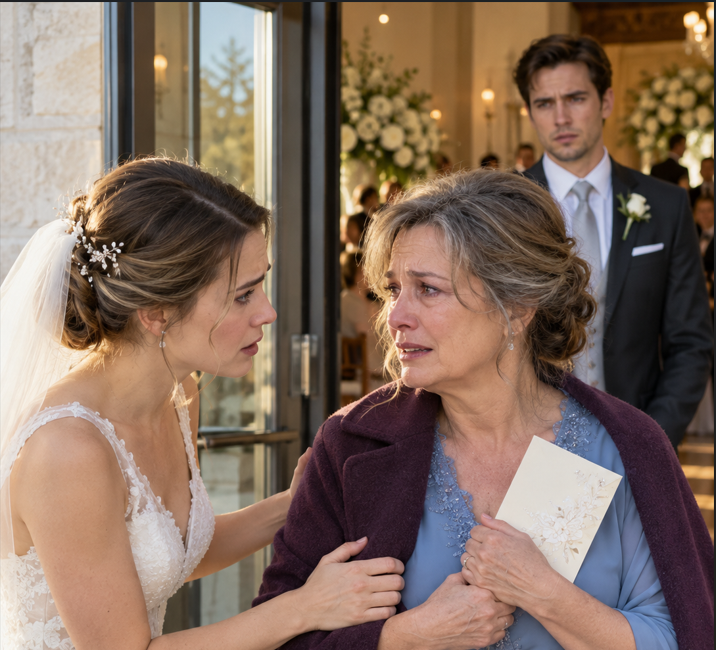
Mom wiped her eyes with a tissue Tessa handed her.
“I should have called you Friday,” she said to me.
“I kept telling myself I wasn’t going to force you to choose between us again.”
“You could have told me,” I said.
“I know.”
I believed her regret.
I could also see how fear had shaped it.
The last time she’d questioned Daniel, she’d lost her daughter for nearly two years.
This time she had tried to be careful, and being careful had left her stranded outside a glass door.
Daniel looked at his watch.
“Are we really going to throw away our wedding over bookkeeping?”
“It’s not bookkeeping,” I said.
“It’s your decision to hide money, shut my mother out, and lie about why she wasn’t here.”
He leaned closer.
“Think about how much you’ve already invested in us.”
I thought about it.
The time, the compromises, the lease we’d once signed together before moving into the condo I owned, the holidays spent alternating between his relatives and my friends, the careful plans we’d made for children we weren’t ready to have yet.
For a moment the size of that investment frightened me more than the amount in our bank account.
Then my phone rang.
It was an unknown local number.
I almost declined it, but Tessa suggested it might be a vendor trying to reach us about the delay.
I answered, keeping the speaker turned low.
“Hello, is this Claire Bennett? My name is Rachel Kim. I’m a real estate broker. Daniel gave me your number. I know today is an awkward day to call, but I need to confirm something before I put any paperwork together.”
I looked at Daniel.
His face changed immediately.
“What paperwork?” I asked.
“For your condo,” the woman said.
“He told me you were ready to list it as soon as you returned from your honeymoon. He asked about a quick-sale price, but I can’t proceed without talking to you directly.”
I had agreed to discuss the possibility of selling my condo one day.
I had never agreed to list it, and I certainly hadn’t agreed to accept a reduced price.
As I stood in my wedding dress with Daniel watching me, I realized the missing wedding money might not be the end of what he had planned.
To find out what Daniel had promised about a home that wasn’t his to sell, read Part 4.