

The attorney’s name was Susan Ellis.
She had helped Rachel and me settle our mother’s estate and had never once pretended that family arguments could be solved with a well-worded letter.
Now she asked us to stay at the church while she called the bank that held our renovation account.
“Your sister is also an owner,” she reminded me.
“I need to speak with both of you before I can say what should happen next.”
Rachel joined the call from her apartment.
Susan had us identify the latest statements we possessed and read out the dates on the transfers we disputed.
The bank would not disclose every transaction over the phone without its verification procedures, but it could confirm that the account was still active and that several payments had gone to a business belonging to Nathan.
The total under review was just over sixty-eight thousand dollars.
I stared at the wall while Susan repeated the figure.
Our mother had left us enough to keep the house standing, not enough to gamble with it.
Rachel and I had set aside the renovation money from savings and a small insurance payment after a storm damaged the roof.
We had trusted Nathan to manage approved contractor bills, not to treat the account as an emergency reserve for his company.
Susan told us to preserve the statements and submit written disputes to the bank.
She would request full records, notify the proposed lender that neither owner had authorized a pledge of the house, and arrange a search of the property records.
She was careful not to promise we would recover the money or that no other documents existed.
“I need you to separate what he admitted from what the records prove,” she said.
“Write down the events while they’re fresh.”
I did.
I wrote about Dad seeing the hidden phone, Mark’s instructions, the planned detour, and Nathan’s request for a signature before the reception.
Lucy recorded what she’d personally witnessed, including the messages Mark had shown her.
Dad wrote his own account in the same blunt sentences he’d used on repair estimates all his working life.
We kept our notes separate instead of trying to make our memories sound identical.
When Susan finished, I went outside.
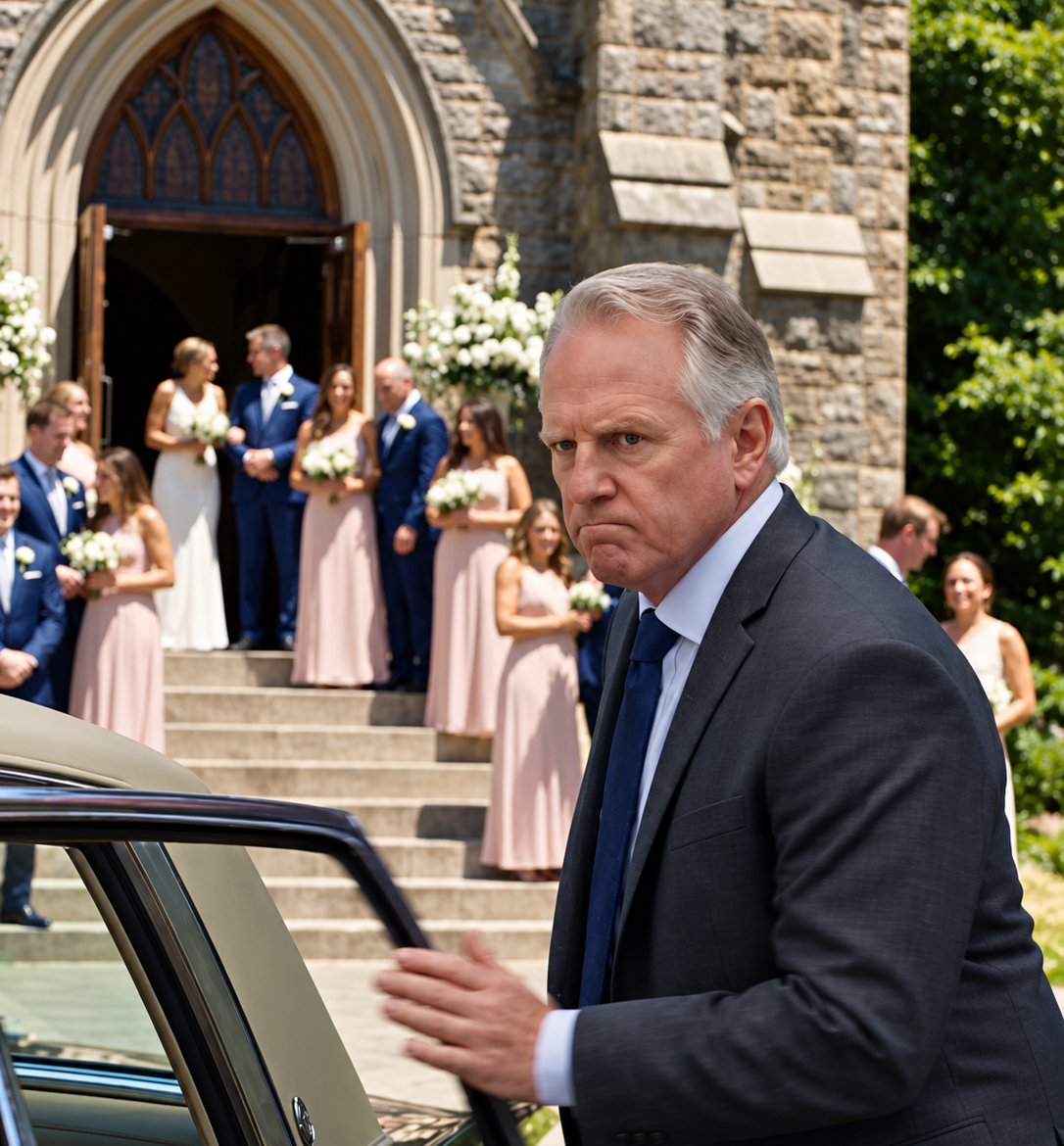
The guests had nearly all left the church.
A few petals lay on the steps, flattened by shoes and tires.
The Cadillac was gone.
Mark had returned it to the rental company after giving us the dispatch information.
Lucy brought my bouquet and the little bag containing my phone charger and flat shoes.
“What do you want me to tell people?” she asked.
“Only that I’m safe and won’t be coming to the reception.”
“Some will ask for details.”
“Then they’ll have to wait.”
She hugged me without saying Nathan’s name.
That was a greater kindness than any explanation she could have offered.
Dad drove me to his house, where I changed out of my dress in the bedroom I’d used as a teenager.
He made coffee neither of us drank.
Before sunset, Rachel arrived with a folder in one hand and a paper bag of sandwiches in the other.
She stopped in the doorway when she saw me.
“I wasn’t sure you’d want me here,” she said.
“I should have wanted you here months ago.”
She set down the sandwiches.
For a moment we stood a few feet apart, both too tired to decide who should move first.
Then I crossed the room and held her.
We didn’t try to settle nine months of hurt in one conversation.
She showed me the original bank alerts she’d kept, and I told her how Nathan had described their argument.
Some of what I had believed about her was simply false.
Other parts were things I’d chosen not to question because the truth would have interrupted the life I wanted.
The following week, Susan confirmed that the private loan had not closed and that the county search showed no new recorded lien connected to Nathan’s proposed deal.
That was a relief, but it didn’t make the diverted renovation funds disappear.
The bank began reviewing the transfers, and Susan advised us on possible civil claims and a report to the appropriate authorities.
We followed those steps without announcing them to relatives or turning the evidence into a public spectacle.
Nathan sent flowers first.
Then came a long email explaining the pressure on his business.
He admitted using part of the renovation money to cover expenses for the Beacon project but argued that his intentions had been good because he expected to replace it.
His lawyer later contacted Susan.
I let them communicate about the money and the house.
For several days Nathan asked me to meet him alone so we could begin married life again.
I agreed to one conversation in Susan’s office, with her present.
He looked smaller without a groom’s jacket and an audience.
“Tell me there’s still a chance,” he said.
“I need to know something first,” I answered.
“If Dad hadn’t stopped the car, would you have told me the truth before we reached that office?”
He watched his hands.
“I would have explained what you needed to know.”
“That isn’t what I asked.”
He didn’t answer.
I knew then that I could care about the man I’d hoped he was and still refuse to build a marriage around the man sitting in front of me.
I asked Susan to help me begin the process of ending it.
The wedding had happened, but no reception photographs or promises could make dishonesty into consent.
The legal and financial matters took months.
We recovered some of the disputed money through a negotiated payment arrangement; the remainder remained the subject of formal claims.
The house stayed in Rachel’s and my names, and we stopped using Nathan’s company for any repairs.
I paid the next contractor myself after Rachel reviewed the estimate with me.
One Saturday in early spring, Dad came to Kingston to fix the porch railing.
Rachel was painting the window trim, and I was inside sorting a box of our mother’s letters.
Through the open door I heard them arguing cheerfully about the correct size of a screwdriver.
For years I’d thought peace meant nobody challenged my choices.
Now I knew silence could be its own kind of danger.
Dad found me by the front window.
“I should have pushed harder when Rachel first came to me,” he said.
“And I should have listened.”
He nodded, accepting his part without asking me to erase mine.
Outside, Rachel called us to help carry the ladder.
I put the letters back in their box and went out with him.
I never took that first ride in the wedding car.
For a long time I remembered only the sound of its door slamming, and how many strangers turned to stare.
Now, when I think of that afternoon, I remember something else: my father standing between me and a decision I’d been kept from understanding, and my sister answering a phone until someone finally listened.
I didn’t get the marriage I’d planned.
I got the chance to make the next decision with my eyes open.
[ FINE.]
I still have a photograph from the church steps, taken just before the car arrived. In it, my father is straightening my veil, and I am smiling toward someone outside the frame. You would never guess what happened minutes later. I used to study that picture and wonder why I hadn’t noticed what Nathan was hiding. But trust isn’t supposed to require you to search every pocket or question every route. Sometimes I think about the black phone beneath the seat and the calls I almost never heard. Mostly, I think about the people who kept trying to reach me when I was certain I already knew the whole story.