

I asked Nadia to request a meeting with the independent investigator before I spoke to Adrian again.
I wanted to understand the document without relying on the man who had signed it to explain what it meant.
The investigator was a woman named Judith Hale who had spent twenty years examining nonprofit and corporate accounts.
She met us in a plain conference room with a pitcher of water, three folders, and no interest in anyone’s family history.
She explained that the document was a continuation authority.
It kept the assistance program funded while a vendor review proceeded, but it also allowed payments to an intermediary called Harbor Care Solutions.
“Was there an original version?” I asked.
“There were several drafts,” Judith said. “We’re comparing them with the executed instruction and with the actual payment approvals.”
“Did Adrian know he was permitting that consultant to be paid?”
“That’s one of the questions we’re putting to everyone who approved or reviewed the documents.”
I told her about the invoices I’d flagged and the handwritten notebook I’d brought to Nadia.
Judith asked to examine copies.
She didn’t tell me I was brave, and she didn’t promise the records would clear me by Friday.
Her professionalism was reassuring.
On the way out, Nadia touched my arm.
“You did what a good witness does,” she said. “You told her what you knew and stopped where your knowledge stopped.”
That distinction was becoming important to me.
For a long time I had filled in Adrian’s silences with explanations because I couldn’t bear not knowing.
I wouldn’t do that with an investigation, even one involving Vanessa.
The following afternoon, Adrian requested another meeting through Nadia.
This time I chose a cafe halfway between our neighborhoods, and I told him I wanted to speak without lawyers for twenty minutes.
Nadia agreed after we set clear limits: no negotiations, no confidential documents, and no promises on anyone’s behalf.
When Adrian arrived, he ordered coffee and left it untouched.
“I’ve seen the instruction,” I said.
“I thought you would.”
“You told us the payments would be held.”
“I was told the disputed invoices were excluded. I should have read the final attachment line by line.”
“Why didn’t you?”
“Because I trusted Vanessa’s assurance and a summary from our finance director.”
I waited for the rest.
“And because I had a closing that day,” he added. “I treated the foundation as something that could be delegated while I handled what I considered real business.”
“Real business,” I repeated.
He nodded, ashamed.
“The housing program wasn’t an ornament on the company website, Adrian. People relied on it to get to treatment.”
“I know that now.”
“You knew it when I explained the budget. You just didn’t listen.”
That hurt him.
I could see it in the way his fingers moved away from the coffee cup.
But he didn’t argue.
“I’m giving the investigators full access to my communications,” he said. “I’m stepping aside from the foundation’s board while they complete their review. If I approved something negligently, that’s my responsibility.”
“What about my name?”
“I’ve asked the audit committee to correct the preliminary assumption that your credentials prove you authorized those transfers. They’ll have to reach their own findings. I won’t pressure them to reach mine.”
It was the first useful answer he’d given me.
Not an apology wrapped around a promise of protection, but a commitment to a process he could not control.
Before he left, he asked whether I was eating and sleeping well.
I almost snapped at him.
Then I noticed how carefully he’d phrased the question.
He wasn’t demanding the ultrasound picture or my next appointment time.
He was asking about me.
“Some days,” I said.
“Can I do anything?”
“Keep doing what you said you’d do.”
He accepted that.
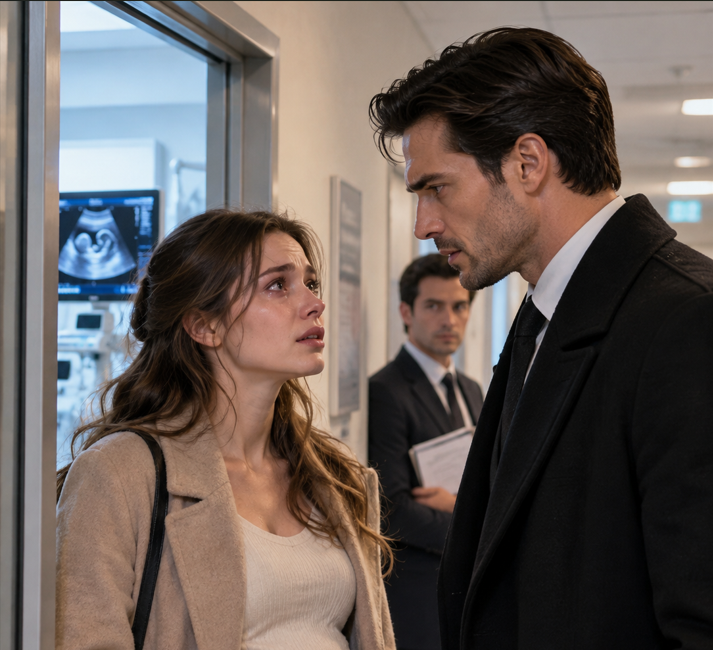
Two weeks later I was twenty-one weeks pregnant and sitting in Dr. Park’s waiting room with Maya beside me.
The anatomy scan took much longer than my first ultrasound.
The technician checked the baby’s heart, spine, limbs, and measurements, then brought the doctor in to review the images.
I watched the screen with my hands folded over the edge of the table.
A small foot moved against the dark background.
“There,” Maya whispered. “I think we’ve got a dancer.”
The doctor said the examination was reassuring.
We still had the usual follow-up appointments ahead, but nothing on that scan required special intervention.
I felt relief so intense it made me lightheaded.
When we got home, I sat beside the dresser we’d bought and looked at the printed images.
Adrian had respected the boundary I’d set.
He hadn’t tried to appear at the hospital or asked anyone there for information.
He’d attended the co-parenting class and sent the certificate to his attorney, who had not forwarded it until I said I was interested.
He’d also arranged regular contributions to an account for shared child-related expenses, with the terms recorded through counsel and no conditions attached to my decisions.
I didn’t owe him an invitation.
Still, I was starting to believe he could become someone our child might know without making my own life smaller.
I asked Nadia to tell him he could have one of the anatomy pictures.
She checked twice that it was my decision.
When his response arrived, it contained just five words.
Thank you for letting me see.
That night, lying in bed, I felt a flutter low in my abdomen.
It was gentle enough that I wondered whether I’d imagined it.
Then it happened again.
I put my hand over the spot and stayed very still.
There was no one beside me, and for the first time the quiet did not feel like abandonment.
It felt like space.
The first public report appeared three days later.
It was a business column about an external audit at Moretti Capital, with a vague reference to grant payments and questions about the chief executive’s oversight.
Claire Bennett wasn’t mentioned.
Neither was the pregnancy.
I felt grateful for both omissions until a photographer approached me outside the pharmacy near my apartment.
“Mrs. Moretti, is it true you’re expecting a child with your ex-husband?”
I stopped so abruptly that the bag in my hand swung against my leg.
“My name is Bennett,” I said. “Please leave me alone.”
He raised the camera.
I walked into the pharmacy and asked an employee to help me call a car.
I had no idea whether he’d noticed me at the hospital or followed someone connected with Adrian.
I only knew I didn’t want my child announced by a stranger on a sidewalk.
I called Nadia from the back seat.
She documented the encounter and advised me not to engage with further questions.
Adrian learned about it through his attorney.
He didn’t call me.
Instead, his representative sent a proposal for a mutual privacy statement making clear that neither parent would discuss the pregnancy or future child with the press.
Nadia revised the wording to make the obligations equal, and we both agreed.
For a man whose instincts had once been to fix problems by taking charge, it was a meaningful change.
He had asked for consent before putting my life into a statement.
A few days later, Vanessa contacted me directly.
Her message came from an unfamiliar number and was short enough that I could read it on the lock screen.
Claire, we need to speak before they turn this into something worse. You know I never wanted you hurt.
I forwarded it to Nadia and did not respond.
Vanessa sent another message the next morning, suggesting that I could help everyone by saying I had understood the consultant payments as emergency program expenses.
The wording was careful.
It didn’t openly instruct me to lie, but it asked me to describe an understanding I had never had.
Nadia told me not to delete anything.
Judith received the messages through counsel.
The next week, the investigators confirmed that Harbor Care Solutions had submitted charges that could not be matched to documented services.
Some payments had gone to an account connected through company records to a business associate of Vanessa’s.
The findings were preliminary, but they were supported by bank records and vendor agreements rather than rumors.
The administrative override used to enter approvals under my name was also tied to a workstation assigned to the foundation’s executive office.
They were still establishing who had operated it.
I wanted to feel victorious.
Instead I thought about the families who had been told that money for transportation and temporary lodging had run out.
I asked Judith how the patients were doing.
She said individual patient information wasn’t part of what she could share, but the program’s administrators were assessing missed assistance requests and restoring services with properly controlled funds.
Adrian made a public statement that he was cooperating, had stepped aside from foundation oversight, and regretted failures of governance.
He didn’t mention Vanessa or me.
He didn’t declare anyone guilty.
For the first time I saw him use his authority to accept uncertainty rather than silence it.
That evening he called through the number I’d finally agreed he could use.
It was the first time I’d heard his voice on my own phone since the divorce.
“I didn’t ask whether I could call about the company,” he said immediately.
“You can ask about the baby,” I answered.
He went quiet.
Then, softly, “How is our child?”
“Growing. Moving sometimes. The last scan looked good.”
I heard him release a breath.
“I wish I’d been there,” he said.
“I know.”
“I also know wishing doesn’t give me the right.”
We talked for eight minutes.
He asked what size clothing a newborn actually needed, whether I had settled on a stroller, and whether he could attend a parenting appointment together later if I wanted.
I told him we’d discuss that after the audit interview.
He said he understood.
The interview date was already on Nadia’s calendar.
Judith had asked whether I was willing to give a formal statement describing my earlier objections to the invoices.
Because the findings might lead to a referral to regulators, Nadia wanted us to prepare carefully.
I was frightened of what public testimony could do to my privacy and my pregnancy.
I was also frightened of what silence would do to the people whose names had been reduced to numbers on a payment report.
The morning before the interview, Nadia forwarded one more document.
It was a copy of my original written request to suspend payment, recovered from the company’s archived records.
Someone had circulated it to the foundation staff with the instruction to remove my name from the review chain.
Below that instruction was a brief reply from Adrian, sent six days before he ended our marriage.
Proceed without involving Claire further. I’ll handle this personally.
I had waited three years for Adrian to make me feel chosen.
Now I had to decide what to do with written proof that, at the moment it mattered, he’d chosen to shut me out.
Follow the decision I made with that message in Part 5.