


When I arrived, Dad was sitting at the kitchen table with an open cardboard box. Mom was gone. She had said she “needed air” and left without telling him where she was going.
Inside the box were years of statements, copies of purchase agreements, wire receipts, and documents tied to real estate held through the LLC. It was not a complete set of books, and I refused to pretend it was. But it gave us a trail.
We followed it.
The first purchase had happened thirteen years earlier: a small fixer-upper on the outskirts of Columbus. The initial funds had come from an account in Mom’s name only. In the months before the closing, deposits had hit that account in amounts and at times that were consistent with some of my transfers.
“Consistent isn’t the same as proven,” I told Dad. “To know exactly where each dollar came from, we need full statements and someone qualified to trace it.”
He nodded.
“She told me that place belonged to a cousin.”
Another property came three years later. Then a garage unit. Then a partial interest in another rental.
Mom had not simply been saving money. Piece by piece, she had built a parallel financial life.
Dad went to the window.
“I really did get hurt fifteen years ago,” he said. “I worked fewer hours for a while. We had expenses. But we were not about to lose the house. And it certainly didn’t go on for fifteen years.”
“So she used something true to sell me something false.”
“Yes.”
It was the perfect kind of lie: enough truth inside it to keep it from ever feeling completely invented.
That afternoon, I called a lawyer I worked with, Rachel Morgan. I told her only what she needed to know: I believed I had been induced for years to transfer money based on false representations, and I needed to understand how to protect myself and preserve records properly.
She stopped me before I could spiral.
“First rule: don’t touch anything that isn’t yours and don’t access any account you’re not authorized to use. Save what you received legitimately and what’s public. Second: stop arguing by text. Third: reconstruct the transfers and the communications.”
It was exactly the kind of clarity I needed.
I spent the next two days exporting my own bank records, downloading emails, and cataloging messages. Every time Mom had written “hospital,” “mortgage,” “urgent,” or “your dad,” I marked the date and the amount that followed.
Not every transfer corresponded to a specific request. Many had become automatic. But that was part of the story too. The original emergency had changed my behavior so completely that she no longer had to ask every month.
Mom shifted from anger to emotional pressure.
“Can we talk like two adult women?”
Then:
“Don’t destroy your father over money.”
And finally:
“If you get lawyers involved, there won’t be a family left.”
That last message made me laugh without humor. For fifteen years, “family” had been the reason I was not supposed to ask questions. Now it had become the threat meant to stop me from finding answers.
Dad hired his own professional advisers. I refused to tell him what to do about his marriage. I only told him he deserved to know his financial position.
Three days later, he called.
“I found out there’s an account I knew nothing about.”
“Whose name is on it?”
“Hers.”
“How much?”
He was quiet.
“Enough to know she never needed your $4,000 a month just to live.”
I closed my eyes.
That evening, I met Rachel in her office with a fifteen-year timeline. She read it carefully and asked precise questions. She did not promise an outcome. She did not turn my anger into a legal conclusion.
“There are things we need to verify,” she said. “Source of funds. Exactly what was represented to you. The altered documents. Limitation periods. But there’s one thing you can do right now: stop acting like you’re the one who has to justify yourself.”
I carried that sentence home with me.
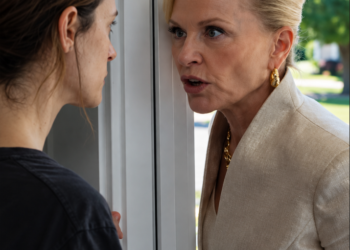
The next morning, Mom was waiting outside my apartment building.
She looked as polished as ever: dark coat, perfect hair, handbag held tight in both hands. She did not look afraid.
Until she saw me.
“We need to talk.”
“We can talk here.”
She glanced toward the street.
“Don’t make a scene.”
“I’m not.”
She stepped closer and lowered her voice.
“If you keep digging, you’re going to lose a lot more than money.”
By then, I had noticed another pattern in my old messages. Her most dramatic requests often appeared soon after I mentioned spending money on myself. Once, I talked about replacing my car; days later came a supposed health emergency. Another time, I mentioned taking a trip with someone I was dating; that week she warned about overdue housing costs. I could not prove every coincidence was deliberate, so I did not treat it as fact. But I stopped dismissing the pattern as meaningless.
Rachel made me keep three separate columns: what I knew, what I could document, and what I suspected. At first I hated it. It felt like she was cooling down something that was obvious to me. Then I understood: she was protecting me from the same trap I had fallen into with Mom, turning a belief into truth simply because it felt emotionally certain.
Dad did the same kind of work on his end. He gathered tax records and documents he had a legal right to review. We agreed not to fill gaps with guesses. If something was unclear, it stayed unclear.
That rule made the confirmed facts hurt more, but it kept us from building a second false story in reaction to the first.
Over the weekend, I indexed the paper copies Dad had given me permission to take. I numbered every document because I did not want to rely on memory when I spoke to Rachel. It was slow, almost boring work, and the boredom helped. Panic became a sequence of verifiable questions: Which account received the transfer? Who owned it? What happened in the weeks afterward? What explanation had I received at the time?
Some months showed nothing important. Others raised serious questions. Accepting the months that did not support my suspicions made me trust the overall reconstruction more.
I was not trying to build a perfect story.
I was trying to find the true one.
For the first time, Mom’s threat did not scare me.
It only told me there was still something she did not want me to find.