

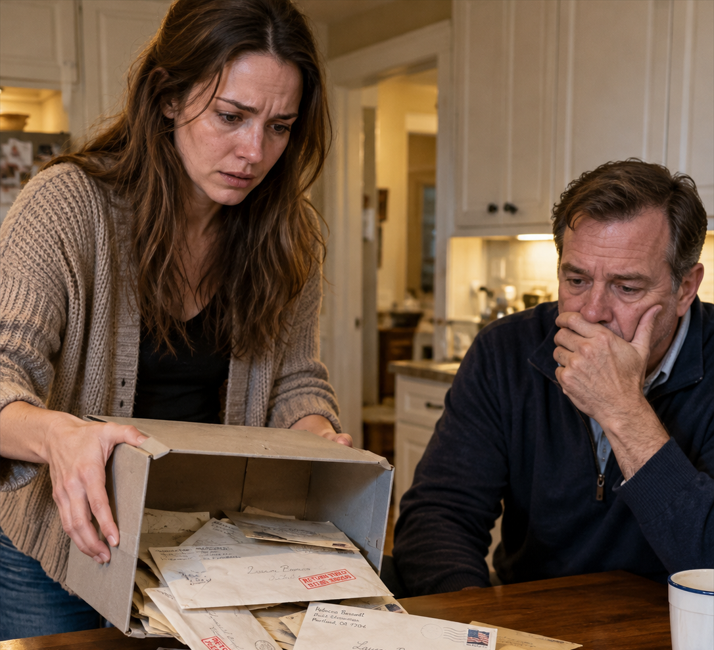
For several seconds, the only sound in the kitchen was the refrigerator humming behind me.
Dad looked down at the envelopes as though they belonged to a stranger who had made a terrible mess in his house.
Then he pulled out a chair and sat.
“I was going to tell you,” he said.
It was such a small sentence for something that had occupied twenty years of my life.
“When?”
“When you were older.”
“I’m thirty-one.”
“I know how old you are.”
“Then tell me now.”
He rubbed a hand over his mouth.
He looked tired, and under ordinary circumstances I would have fetched him a glass of water.
That frightened me almost as much as the letters.
Even with the evidence spread between us, part of me was still looking for a way to make him comfortable.
“Your mother left,” he said finally.
“That part is true.”
“It isn’t the part I’m asking about.”
“She wasn’t happy. She wanted a different life.”
“And the letters?”
“I thought they would confuse you.”
I stared at him.
“You told me there weren’t any.”
“I was trying to give you some stability.”
“You could have given me a letter.”
He shook his head as if I had failed to understand something obvious.
“You were a little girl who cried herself to sleep. You don’t remember what those months were like.”
“I remember enough.”
I remembered standing at that same kitchen counter, pressing my face against his shirt because I couldn’t understand why my mother had not come home.
I remembered him rubbing my back and saying we would be all right.
For years, that memory had been proof of his goodness.
It was still a memory of kindness.
I simply no longer knew what it had cost me.
I reached for the envelope nearest my hand.
The postmark was dated April 2006, less than a month after Mom left.
I broke the seal carefully, afraid the paper would tear.
Dad’s chair scraped against the floor.
“Lauren, please.”
I read anyway.
The letter began, “My beautiful girl.”
My mother had written that she knew I was angry and confused.
She said the separation was between two grown-ups and that I had done nothing to cause it.
She told me she had not stopped loving me, even for an afternoon.
She asked me to remember a ridiculous song we used to sing when the toaster burned breakfast.
And she ended with a promise: “I’ll keep trying to reach you. You don’t have to write back until you’re ready.”
I had forgotten the toaster song.
But when I saw the words, I heard her singing it with a mouth full of laughter.
For a moment I was eleven again, reaching across the kitchen for a memory I had never meant to lose.
“She told me she loved me,” I said.
Dad stared at the window.
“She said a lot of things.”
“You said she never said anything.”
He didn’t answer.
I opened another letter.
This one was dated June 2006, a week before my twelfth birthday.
It contained a birthday card with a crooked drawing of a bicycle on the front.
Mom wrote that she had found a blue bicycle bell at a thrift store and thought of the summer we had spent learning to ride without training wheels.
She said she would hold on to it for me.
The envelope remained sealed until that moment.
On my twelfth birthday, Dad had taken me out for pancakes and told me not to ruin a perfectly good morning by asking about her.
I had apologized to him.
The memory made my stomach turn.
“Did you open any of these?” I asked.
“No.”
“Then how did you know they’d confuse me?”
He pushed his chair back but didn’t stand.
“I knew your mother.”
“You knew what you wanted me to think of her.”
That was the first time I had ever said something like that to him.
I expected anger.
Instead, he looked briefly, terribly wounded, as if I had accused him of being a stranger.
“Everything I did was for you.”
“I believe you told yourself that.”
My voice sounded steadier than I felt.
I gathered the envelopes into piles according to their postmarks.
There were forty-three that I could count without opening them all.
Some had been sent twice in one year.
Others marked birthdays, Christmases or ordinary Wednesdays.
The earliest came from an apartment across town.
Later ones listed an address in Lancaster, Pennsylvania.
There were changes in handwriting, changes in stamps, changes in the way Mom formed my name.
The one thing that had not changed was the fact that none had reached me.
“What does ‘return to sender’ mean?” I asked.
Dad looked at the red lettering.
“Exactly what it says.”
“But they’re here. They weren’t returned.”
He was quiet for so long that I thought he would refuse again.
“I marked them,” he admitted.
“I had a stamp at the office. I intended to send them back.”
Dad had managed the mailroom for a regional supply company for years.
When I was little, he sometimes let me help sort empty envelopes on his desk.
I remembered the ink pads and the rubber stamps, the way he insisted every label be straight.
“Why didn’t you?”
“At first I didn’t want her thinking she could start again just by writing a nice letter. Then it had been months, and I couldn’t decide what to do with them.”
“So you hid them.”
“I put them away.”
“For twenty years.”
He lowered his eyes.
I held up a letter postmarked in 2019.
“You were still putting them away when I had my own apartment, my own job, my own phone. You didn’t even ask what I wanted.”
“You weren’t interested in her by then.”
“Because you spent my childhood telling me she wasn’t interested in me.”
He finally raised his voice.
“You have no idea how hard it was to raise you by myself!”
I flinched.
Not because he shouted often; he almost never did.
But because the argument was so familiar.
When I had been a teenager and asked for something he couldn’t afford, he would remind me that he’d been both parents.
When I chose a college two hours away, he asked whether I understood what leaving would do to him.
I had always understood his sacrifices as a debt I owed.
“I know you worked hard,” I said.
“I know you cared for me. Those things are real. But they don’t make this all right.”
He looked at the letters again.
“You didn’t see her walking away.”
“No. I was eleven. I saw what you let me see.”
I found an envelope from December 2007 and opened it.
The letter inside was only a page long.
Mom had written about waiting at the Maple Street Library on a Saturday afternoon.
She described the children’s table near the front windows, where she had sat with two hot chocolates until the drinks went cold.
She wrote that Dad had told her I couldn’t come, but she wanted me to know she had been there.
I knew that library.
Dad had taken me there on Saturdays after the divorce, sometimes as a special treat.
I could picture the front windows and the little metal chairs.
I could even remember one Saturday when we turned around in the parking lot without going inside.
He said the building was closed for an event.
I had been disappointed because I’d wanted a new book.
“What was happening at the library?” I asked.
He looked at the envelope, then at me.
“Your mother wanted a visit.”
“Did you tell me?”
He looked away.
“Dad.”
“You were having trouble sleeping.”
“Did you tell me?”
“No.”
I put the page down because I could no longer trust my hands.
I had spent two decades believing the absence of my mother was a decision she made alone.
Now I knew at least part of that absence had been arranged for me.
I still didn’t know why she had moved out, what she’d tried to do afterward, or why she hadn’t found another way to reach me.
Those questions mattered.
But the answers could not change what my father had just admitted.
I took my phone from my pocket and photographed the envelopes, the postmarks and the red stamps.
Dad watched but didn’t interfere.
Then I returned every letter to the box.
“I’m taking them home.”
“They’re my things,” he said automatically.
“They’re addressed to me.”
“Lauren, don’t make a decision you’ll regret tonight.”
I paused at the doorway.
“Do you hear yourself? You’re still trying to decide for me.”
He stood, his expression slipping from anger to alarm.
“I don’t want to lose my daughter over something that happened a long time ago.”
I wanted to tell him he had already lost something.
But I didn’t yet know exactly what.
In my car, I called my best friend, Abby.
We had met in college, and she was one of the few people who knew how much my mother’s absence still hurt.
When she answered, I asked whether I could come over.
“Of course,” she said.
“Are you okay?”
“I don’t know.”
She didn’t press me.
She just told me to drive carefully.
At Abby’s apartment, we spread the letters across her dining table.
She brought me tea I didn’t drink and a clean notebook for the dates.
For two hours we worked through the envelopes in order, recording when each had been mailed and where it had come from.
I read some letters aloud.
Others I could barely whisper.
Mom wrote about starting a new job, about ordinary days, and about wondering whether I still liked thunderstorms.
She wrote on my sixteenth birthday that she wasn’t sending a lecture about growing up, only a wish that I had someone to talk to when things became complicated.
The letter made me cry harder than any of the others.
I had needed someone to talk to at sixteen.
I just hadn’t known I was allowed to want her.
Near midnight, Abby found the newest envelope.
It had been mailed in May of that year.
Its return address was a small house on a quiet street in Lancaster.
“You don’t have to open another one tonight,” Abby said.
“I do.”
The letter was different from the others.
It was shorter, and the handwriting looked slower.
Mom wished me a happy thirty-first birthday a few months early, explained that she still lived at the same address, and said she wasn’t certain whether her letters went anywhere at all.
Then she wrote something I had to read three times.
“If you ever want to ask me what happened outside the courthouse, I’ll tell you. I should have told you years ago, even if it made me look less brave than I wanted you to believe.”
I set the page beside the notebook.
Until that moment, I’d imagined the missing truth was confined to one house, one closet and one man.
Now there was a courthouse, a decision I knew nothing about, and a mother who was still offering to explain.
I had to find out what had happened outside that courthouse, and why my father had built my childhood around keeping it from me.
To hear what my mother had never been allowed to tell me, continue with Part 3.