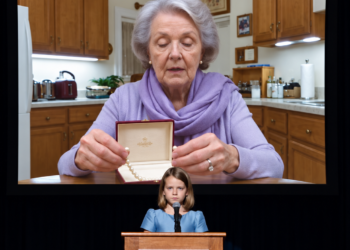



For fifteen years, I sent my parents $4,000 every month. I gave up vacations, relationships that could not survive my constant anxiety about money, extra retirement contributions, and even decent groceries when my checking account got too thin.
Then, on Christmas night, I heard my mother laugh about everything I had sacrificed.
“Emily owes us that money,” she told my aunt. “We gave up eighteen years of our lives raising her.”
I did not walk into the room. I did not yell. I picked up my coat, drove back to my apartment in Columbus, Ohio, and opened my laptop.
That night, I calculated how much I had paid for the privilege of being their daughter.
$720,000.
And the number was only the beginning.
It had started when I was twenty-seven. I worked as a legal assistant at a Columbus firm that handled civil litigation. I made enough to live independently, but not extravagantly. One evening my mother, Diane, called me in tears.
“Emily, your dad had an accident.”
I shot up from the couch. “What happened?”
“He fell at work. He won’t be able to put in the same hours for a while. Between the doctor visits, physical therapy, and the house payment, we can’t keep up. The bank is breathing down our necks.”
My parents lived in Delaware, Ohio, in a modest two-story house with a small front porch my father had repaired a dozen times and a kitchen table where I had done homework as a kid. The idea of losing that house felt unbearable.
“How much do you need?”
There was a pause.
“Four thousand a month. Just until we get back on our feet.”
The amount was almost absurd compared with what I earned then. I said yes anyway.
During the first year, I took every extra hour I could get. I stopped contributing beyond the minimum to retirement. I learned the price of every item in my grocery cart. When Mom mentioned another medical bill, I was the one reassuring her.
“We’ll get through it.”
By the third year, I had stopped asking when “temporary” would end. By the fifth, the transfer was automatic. On the first of every month, $4,000 disappeared from my account. Not long after, I would get a message from Mom.
“You’re an amazing daughter.”
Sometimes Dad would add, “I don’t know what we’d do without you.”
Those words kept me inside a system I could no longer see from the outside. When I lost my job for four months, I used credit cards rather than miss a payment. I never told them. I was ashamed that I could not carry what I had come to think of as my responsibility with ease.
Fifteen years. One hundred eighty transfers. Not one missed month.
Then came that Christmas.
I had driven to Delaware with a pie and a bottle of wine. While I was hanging my coat in the guest room, I heard my aunt Linda talking to my mother in the dining room.
“Diane, Emily has done so much for you. Fifteen years is a lifetime.”
Mom laughed.
“Oh, please. She owes us.”
I stopped in the hallway.
“We supported her for eighteen years,” Mom continued. “Food, clothes, school. Now she can afford to give something back.”
Linda hesitated. “Four thousand dollars every month?”
“She can afford it.”
She either did not know or did not want to know that I bought nearly everything on sale, carried credit-card debt, and had delayed building any real financial security of my own. In that moment I understood that what I had mistaken for gratitude all those years might never have been gratitude at all.
It was expectation.
I left without letting anyone see me.
Back home, I pulled fifteen years of bank records. My job had trained me to read documents carefully, spot inconsistencies, and reconstruct events from details other people overlooked. For the first time, I used those skills on my own family.
$4,000. Twelve months. Fifteen years.
$720,000.
Then I checked the county property records I could access legally and went through old paperwork I had saved. The mortgage story did not line up. I found medical invoices Mom had sent me over the years. Some had provider names, addresses, or formatting that did not match the dates printed on them.
My hands went cold.
For three days, I compared only what I could verify lawfully. The emergencies she had described did not match the records. And the more dates I reconstructed, the harder one possibility became to ignore: my father did not seem to know what story my mother had been telling me.
As I worked, I realized how much of my memory had organized itself around those monthly transfers. I remembered a job interview because it happened two days before payment day. I remembered the end of a relationship because I had refused a weekend trip, saying I could not afford it. One sacrifice at a time had seemed reasonable. Put in order, they described a life built around an emergency that never ended.
I also reread old messages from Mom. They were rarely direct commands. They were more effective than that: “This month is rough.” “Your dad is worried.” “I hope the bank gives us more time.” I always answered the same way, promising I would take care of it. She knew exactly which fear to press: the fear of being a selfish daughter.
Before New Year’s Eve, I printed only what I could explain with confidence. I highlighted dates, amounts, and inconsistencies, separating facts from suspicions. I did not want anger doing the talking for me.
On New Year’s Eve, I drove back to my parents’ house with a folder.
The family was still at the table when I set it in front of my mother.
“Since you keep talking about what I owe you, I calculated the balance.”
I slid the summary across the table.
“Seven hundred twenty thousand dollars.”
My father, Robert, picked up the page. “Seven hundred twenty thousand?”
“Yes.”
I told him about the accident, the medical bills, and the bank that Mom had said was about to take the house.
His face changed.
“Diane,” he said quietly, “what did you tell her?”
Mom tried to wave it away. Dad hit the table with his palm.
“We never had a mortgage problem anything like that.”
Then I pulled out the last document.
Mom recognized it before I placed it on the table. The confidence disappeared from her face.
“Emily,” she whispered. “Don’t.”
I set it down anyway.
“This is what told me where I need to start looking for my $720,000.”
Dad read the heading, then the first line. He went pale and dropped into his chair.
The document did not just suggest Mom had lied about the house. It pointed to assets and transactions neither Dad nor I knew existed.