


“Your mother never wanted you. Not once.”
My father said it across the kitchen table, looking me straight in the eyes.
I was standing in front of him with a worn cardboard shoebox in my hands.
“Then explain this,” I said.
He glanced at the box.
And for the first time in my thirty-one years, I saw my father look genuinely afraid of something I was holding.
“Where did you get that?”
“From your hallway closet.”
His expression changed.
“Put it back, Lauren.”
I didn’t move.
Because twenty years earlier, that same man had told me my mother walked out of our house and never looked back.
And I’d believed him my entire life.
I was eleven when Rebecca Bennett disappeared from my daily life.
I still remembered standing at the living room window, waiting for her car to pull into the driveway.
Dad told me she’d gone away.
At first, I thought he meant for a few days.
Then a week passed.
Then another.
Eventually, I asked when she was coming home.
“She’s not,” he said.
“Did she call?”
“No.”
“Can I call her?”
He looked away.
“She doesn’t want to talk, sweetheart.”
I didn’t understand how someone could stop wanting to talk to their own child.
But I was eleven.
And Frank Bennett was my father.
He packed my lunches, took me to school, helped with homework and stayed up when I was sick.
He was the parent who remained.
So when he told me Mom had abandoned us, I accepted it.
Even when accepting it hurt.
By the time I turned sixteen, I’d stopped asking about her.
At eighteen, I told myself I didn’t care.
At twenty-five, I thought I had finally made peace with it.
But the truth was, every birthday still carried a small, embarrassing part of me that wondered whether she remembered.
My father always noticed when I got quiet.
And he always said the same thing.
“Lauren, you have to stop waiting for someone who doesn’t want to be here.”
For years, that sentence shaped everything I believed about my mother.
Then, on an ordinary Thursday evening, I found the box.
Dad had decided to repaint the hallway and asked me to help clear out the storage closet.
It was full of old towels, holiday decorations and things nobody had touched in years.
I was moving a stack of folded blankets when I noticed a shoebox pushed against the back wall.
The lid was slightly crushed.
There was no label.
I nearly put it aside without opening it.
Then I noticed a corner of an envelope sticking out beneath the lid.
Written across the front was my name.
Lauren Bennett.
Not the adult version of my name on bank statements and utility bills.
My full name in careful handwriting, addressed to the house where I’d grown up.
I lifted the lid.
Inside were envelopes.
Dozens of them.
Some yellowed with age.
Others surprisingly clean.
They were stacked neatly, with their corners carefully aligned.
I picked up the top one.
The return address made my stomach tighten.
Rebecca Bennett.
My mother’s name.
I stared at it for several seconds.
Then I noticed the red writing across the front.
RETURN TO SENDER.
I checked another envelope.
Same name.
Same address.
Same red words.
The dates were different.
Some letters had been mailed years apart.
And every envelope I could see was still sealed.
My hands started shaking.
I sat down on the hallway floor with the box on my knees.
For twenty years, Dad had told me my mother never wrote.
Not on my birthday.
Not at Christmas.
Not even once to explain why she left.
Yet here were letters with my name on them.
Letters that had somehow ended up hidden in his closet.
I wanted to open one.
My fingers even slipped beneath the edge of a flap.
But I stopped.
Whatever was written inside, I couldn’t bring myself to read it while sitting alone on the hallway floor.
First, I needed to understand why my father had them.
I carried the shoebox into the kitchen.
Dad was rinsing a coffee mug at the sink.
“Can I ask you something?”
“Sure.”
“Did Mom ever write to me?”
He didn’t turn around.
“No.”
“Not once?”
He set the mug in the drying rack.
“Lauren, we’ve been through this.”
“I know what you’ve told me.”
“Then why are we doing this again?”
I looked down at the box.
“Because I need to hear you say it.”
He turned.
His eyes moved from my face to the shoebox.
For a moment, he said nothing.
Then his expression hardened.
“Your mother never wanted you. Not once.”
I felt the words land somewhere deep in my chest.
But this time, instead of believing him, I held up the box.
“Then explain this.”
His face changed instantly.
“Where did you get that?”
“From the closet.”
“Put it back.”
“Why?”
“Because those are old things that don’t concern you.”
I almost laughed.
“Don’t concern me?”
He stepped toward the table.
“Lauren, I am not having this conversation.”
“Are they from Mom?”
He looked at the hallway.
“You’re making something out of nothing.”
I placed the box on the table.
“Then look at me and tell me she never wrote.”
His jaw tightened.
“I already told you.”
I lifted the lid.
He reached toward it.
“Don’t.”
I pulled the box away from his hand.
“Why are you trying to stop me?”
He exhaled sharply.
“You don’t understand what you’re looking at.”
“Then help me understand.”
He said nothing.
I thought about every birthday I’d spent waiting for a call.
Every Christmas I’d pretended not to check the mailbox.
Every time I’d convinced myself that my mother must have forgotten me.
And suddenly, I realized how much of my life had been built around something I’d never been allowed to question.
I gripped the shoebox with both hands.
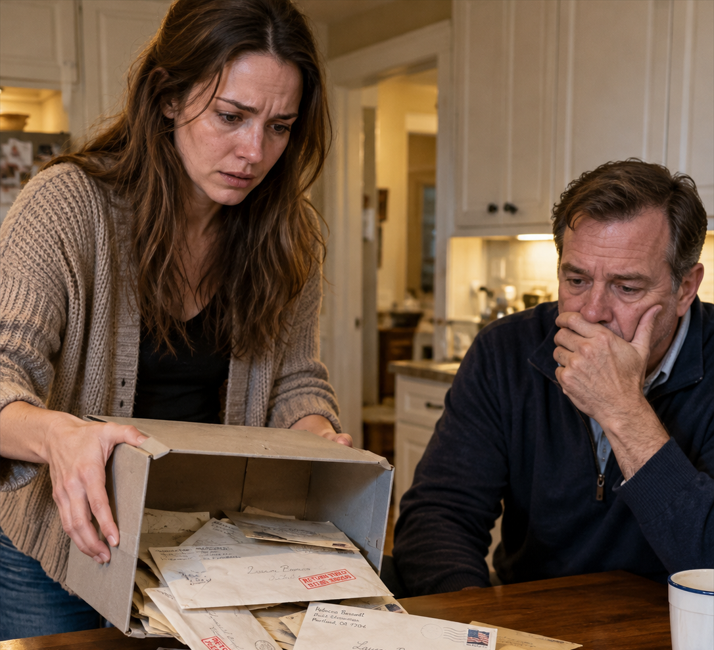
Then I turned it upside down.
The envelopes spilled across the wooden table.
Dozens of them.
Some slid against Dad’s coffee mug.
Others scattered toward the edge.
One landed directly in front of him.
My name was clearly written on the front.
Another showed my mother’s return address.
And across several envelopes were the same red words.
RETURN TO SENDER.
Dad stood completely still.
I picked up one of the sealed letters.
The paper was slightly yellowed, but the handwriting was unmistakably addressed to me.
I looked at my father.
The man who had raised me.
The man who had told me, over and over again, that my mother never cared enough to write.
“Then why did you keep every letter?”
His mouth opened.
But no sound came out.
One hand slowly closed around the edge of the table.
His knuckles turned white.
And for the first time in twenty years, my father had no answer.

At Her Husband’s Awards Dinner, Claire’s Daughter Asked Her for Five Minutes
Part 1 - The Five-Minute Promise “Mom, don’t go. Give me five minutes.” Claire Harrison had already picked up her...
Read moreDetails